Showing posts with label philosophy. Show all posts

Monday, July 06, 2009

'supdate

if you've been grieving my blogospheric absence, let me fill you in on where i've been:

nowhere really – just busy!
i stepped in at the last minute to do a sermon on prayer, a great time - though not long enough - to think through whether i really do value prayer or not.

essay on Isaiah 26 was great fun, but took waaaaay too long - i spent 2 and a half weeks working on the Hebrew, and only a couple of days looking at the theological issues surrounding it.

next on the list was exam fun and games - philosophy was first, and then Church History (European Reformation).

the mayhem was broken up with a weekend camp for SWAC youth, where i had the honour of talking through 2 Peter with them.

i arrived back in time for my New Testament exam, translating and exegeting 2 passages from John 7:29-31 and John 1:11-13. it was good fun, but there was a little too much winging-it, not quite enough knowing-what-on-earth-i'm-talking-about.

i arrived back yesterday from speaking at a vision valley snow camp on the two sons in Luke 15. it was a great couple of days, very tiring, but an awesome opportunity to share the reckless love of our heavenly father with some young people who may not have heard of it ever before.

anyway, i'm off to Gradcon in a couple of days, i just need to knock this essay on the head before then!


anyway, that's where i've been. i hope you've been well too, dear reader.

speak soon,
D5

Sunday, May 17, 2009

David Hume could out-consume

6. Locke, Hume and empiricism: In what ways do these thinkers differ from Descartes?


It seems the empiricists, most especially in Locke and Hume, were the new sceptics. They sought to question knowledge, truth, work out on what basis we know things. Locke questioned in particular how we connect with objects in the real world – and decided that we didn’t! Rather, we have ideas in our heads of objects, and it is in the world of ideas that there is interaction, rather than physically coming into contact with another physicality. However these ideas we contract from experience (a posteriori), and only after seeing something can we have an understanding of that object and others like it. It is as if we are blank slates, who accumulate forms as we go, and build on these more simple ideas to understand more complex ideas.


However, Hume’s thinking in light of Locke about how we gain knowledge led him to question the idea of causality – concluding that we believe the idea of cause and effect, but only from habit, not from any abstract reasoning. In the famous billiard-ball analogy, we may expect a certain result from one striking another, but there is nothing inherent in one billiard ball that should mean its interacting with another ball should have the expected result.


From a small amount of reading, it seems as if the empiricists are leaning towards an atheistic, or at least deist, world-view, whereas the rationalists (in Descartes) saw God as the glue that held everything together. When Descartes asks why a thought leads to an action, he cannot see this as anything but secondary to the will of God who first thought and acted, and from whom all thoughts and actions stem. The empiricists however, although publicly agreeing (Locke more than Hume) that the idea of God ‘makes sense’, see God as having no part in the process – the mind wills and the arm moves. Why does it happen? Because we’ve seen it happen before.


This idea of a general movement towards atheism (or deism) is further shown in Hume’s discounting of miracles – his experience tells him that the normal way of things is for miracles to not happen. If given the choice between miraculous and the empirical, he concludes, the sane man has only one choice.


this is part of a series

Wednesday, March 11, 2009

Plato, they say, could stick it away...

  1. Plato: What is Plato’s theory of forms, and how does his ‘cave’ story help explain the theory?

One of the key problems Plato sought to solve was the relationship between forms and matter. In response to the Sophists, with particularly Gorgias’ radical scepticism, Plato sought to find a better answer than agnosticism, yet was dissatisfied with empiricism. Thus the sign in front of his Academy: ‘Let none but geometers enter here;’ his concern was with the formal sciences, with abstract ideas. For these abstract ideas, or forms, are part of the primary world, yet a metaphysical realm, yet one which is more real than this world which we inhabit. It follows then that this world is somehow corrupted – as the matter differs in its degree of correspondence to the ‘idea-’ or ‘form-world’. However, as Plato has Socrates ascertain in elucidating the Pythagorean theorem from an uneducated slave, within our souls we have this true knowledge of the forms.

The problem is however education. Education – from ‘educare’ (to lead out) – is quite literally Plato’s goal. We are all, he believed, in a darkness as if we were shackled to one another in a cave, looking at the flickering shadows on the cave wall. Since we have been in this state for such a long time, this is all we could believe to be reality. We are not cognizant of the source of the shadows, that they are only rough, imperfect representations of what is creating them. As we are led out of the cave, or educated, blinded as we may be at first by the light, we are then able to understand for the first time the forms that had been making the deceiving shadows.

The way for this education to happen is not by observing nature by experience (a posteriori knowledge), but by contemplative reasoning (a priori knowledge). Thus the best way to spend one’s time is in this honourable pursuit – contemplating the forms, the essences, rather than the materials, sciences, the receptacles of the forms.


this is part of a series

Thursday, February 19, 2009

Wood - Epistemology

all grown up now - finished my bridging assignment (with a respectable 'Pass' mind you), and into Philosophy 2.

set reading: Wood, W, Jay, Epistemology: Becoming Intellectually Virtuous. Leicester: Apollos, 1998.

some highlights from chapter 1:
  • We achieve excellence in the intellectual life, according to this tradition, when we form within ourselves qualities like wisdom, prudence, understanding, intellectual humility, love of truth and similar traits—in short, as we embody intellectual virtues.

  • Your intellectual life is important, according to [Aristotle, Augustine and Aquinas], for the simple reason that your very character, the kind of person you are and are becoming, is at stake.

  • God cares about how you think, not just what you think. A godly mind is not merely one devoid of vile thoughts, nor are the faithful stewards of the mind necessarily the ones who die with all their doctrinal ps and qs in place (brainwashing might as effectively accomplish this).

  • "The good of the intellect is truth," writes Aquinas, "and falsehood is its evil.

  • Søren Kierkegaard stresses the importance of those truths that nourish the soul.

  • i think it would be really easy to just 'do' philosophy - but this collection of quotes is reminding me that that is a dumb attitude. whether Christian or non-Christian, being intellectually lazy - not thinking about what you believe, why you believe, what what you believe means - isn't really an option. this isn't to say that everyone needs to or should nerd-up (as Wood helpfully notes), but we need to be thoughtful about what, why, and wherefore.

    Monday, January 26, 2009

    Descartes, Descartes, ... I drink therefore I am.


    5. Descartes and rationalism: How did Descartes seek to secure true knowledge?


    Biographically, it seems the way Descartes started out on his philosophical journey was thinking – the story goes that he was loathe to rise early in the morning and it was only when this was accepted by one of his Jesuit tutors that was he able to spend his mornings not engaged in chores but meditating, or thinking.
    What he arrived at after his many mornings spent in thought would later be known as the Cartesian method (from DesCartes). And what was his method? Quite simply – doubt everything! Then one could be free to establish true knowledge from the ground up. He did this not by doubting himself and all things out of existence, but indeed by proving his existence primarily in his doubting. For his doubting was if nothing else thinking, and as his famous dictum states, ‘cogito, ergo sum’, or, ‘I think, therefore I am’.

    As the father of the rationalists, Descartes sought to reduce things to its base parts. This was part one of his method – the analysis, followed then by the synthesis – the rebuilding thereafter of the problem to get an understanding of the big picture. He saw this as not dissimilar to an architect building a house – starting first with digging the trenches, and working upwards from there.

    He did see some things which were beyond breaking up, beyond doubt – although his only basis for those things was that there was a good God who would prevent these things from being deceptions. This God he proved by the ontological argument (the starting point being not dissimilar to Plato’s forms) – that if we can imagine any God, inferior as the idea may be, the idea shows that there must be something even greater – and that is greater (this idea not dissimilar to Islam’s ‘Allah Akbar’ – ‘God is greater’ (than anything you could imagine)).


    this is part of a series. check here for others in this series.

    Monday, January 12, 2009

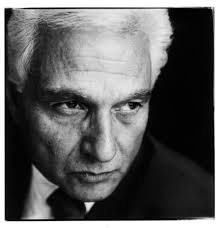
    9. How do you solve a problem like Derrida?

    Derrida: Why does Derrida ‘deconstruct’ things?


    Derrida was motivated primarily by political and ethical reasons. From a linguistic perspective he was interested in being aware of the histories and bases and implications of the language we use, for much of what we say can have meanings beyond what we may be aware of. He raised awareness of this by closely scrutinising the text to discover what else it may be saying. What may be seen as literal may indeed be a caged metaphor, with a whole world of meaning possible. And what may be discovered, at least this is his premise, is that within the thesis there is also the antithesis.
    So when he looks at something such as forgiveness, he discovers a paradox: to forgive someone means that the deed was forgivable. But if that deed was forgivable, then it was hardly worth forgiving them in the first place. Rather, what truly deserves forgiveness is the truly unforgivable act. Yet this act is so heinous that it, by definition, is unforgivable. Uncovering such a paradox should then change the way we see something such as forgiveness – viewing the small forgiveness as but a picture of the big act that truly requires forgiveness.
    Forgiveness and justice (and indeed his whole project), are ultimately impossible things. Yet they occur daily, and should be pursued, but must be more properly understood. For Derrida then, deconstruction is no idle task, for it reshapes our ethics, pulling them apart, like the reductionists of long ago, helping us see what is at the heart of them. His hope is then a real sincerity in the way we relate, and a decrease in dogmatism.
    From my brief reading about Derrida, it seems that although unique, he was influenced by Kierkegaard, Roland Barthes, and even bears some semblance to the psychoanalysts.
    It should also be noted that Derrida sees language as iteratible, that is, easily transplanted and ‘emic’ meaning thence lost. Thus there is no sanctity in language as such, the deconstructor is free to pull it apart as much as one will.

    i should add, i've been reading On Cosmopolitanism and Forgiveness to help me think through this. more on that book in particular later

    this is part of a series. check here for the others uploaded.

    Monday, January 05, 2009

    8 - Nothin' Nietzsche couldn't teachya

    Nietzsche: In what ways did Nietzsche disagree with most of what had gone before him?


    The most overwhelming difference to those before Nietzsche was his foundation. Whereas they were interested in proofs for God, he had Zarathustra proclaim ‘God is dead’. Whereas they were interested in understanding why we think the way we do, he told us we thought wrong.

    Born into the new era of an evolutionary understanding, he sought to apply this to religion, philosophy and logic. As such, he saw that humanity has been going about their business poisoned by Christianity. We had adopted a slave mentality, or herd mentality. We needed to rise above this, put off this pitiful state, and courageously take on our true nature – the mentality of the master or the nobleman. Indeed, Nietzsche saw those things inherited from Christianity not as the pinnacle of humanity, but as its lowest point, the point at which it began to fall below that of even the animals. His goal then was to shatter the idols that propped up the weak, that held us down in guilt.

    He saw only a few in history to have risen above this guilt (such as Napoleon or Alexander the Great), and he calls this archetype der Übermensch. They were those who pursued their will to power, or to overpower. He saw this as our truest desire.
    As regards teleology, he saw each one of us as having this overpowering as our goal, yet macro-history he saw as cyclical – if there were a goal, we surely would’ve reached it by now! Yet his nihilism means that there is no purpose for pursuing this course except for being honest to ourselves.

    Uniquely among philosophers, Nietzsche ventures into realms previously only really entertained by theologians – dealing with questions of suffering, yet obviously from an atheistic perspective. His famous maxim that ‘what doesn’t kill me makes me stronger’ is of little comfort to those suffering, but like Machiavelli’s Prince, one wonders whether Nietzsche’s Übermensch should have any concern for such a soul.
    Finally, one fascinating way Nietzsche stands apart from his forerunners is his absurdist view of his own discipline. The happy philosopher is the philosopher happy to rely on appearances – to go on instinct – he does not need to constantly justify everything or seek a higher status of affirmation than his own. What a truly emancipatory view of thought!


    as hinted at last post, this is a part of my requirements for entering Philosophy 2. please feel free to comment, correct any assumptions i've made, suggest ways of clarifying my thinking.
    oh, and very copywrite.

    Thinking like a Philosopher :: Series

    To get into second year Philosophy (i did fun subjects like World Religions and the Gospel instead in first year), i've had to write 3,500 words all up on various philosophers, 250-400 per topic.

    As i publish them, come back here to see the newest ones.

    But they are:

    1. Plato: What is Plato’s theory of forms, and how does his ‘cave’ story help explain the theory?
    2. (a) Aristotle: How does Aristotle differ from Plato?
      OR
      (b) Aristotle: Briefly summarise what teleology meant for Aristotle.
    3. Aquinas: In what ways was Thomas Aquinas interested in philosophy?
    4. Theology: What are some examples of the impact of Greek philosophy on Christian theology?
    5. Descartes and rationalism: How did Descartes seek to secure true knowledge?
    6. Locke, Hume and empiricism: In what ways do these thinkers differ from Descartes?
    7. Kant: Why might Kant be described as ‘the answer’ to the dispute between rationalists and empiricists?
    8. Nietzsche: In what ways did Nietzsche disagree with most of what had gone before him?
    9. Derrida: Why does Derrida ‘deconstruct’ things?
    10. Philosophy and theology: In what ways does the study of philosophy help, and/or hinder, the study of theology?

    hang on for the ride.

    by way of bibliography, to be honest, it's pretty loose. in the end, i drew fairly freely from the following works (whilst hopefully refraining from plagiarism of any kind - i went with the vibe):

    Sproul, R.C. The Consequences of Ideas: Understanding the Concepts that Shaped Our World. Wheaton: Crossway, 2000.
    Fearn, N., Zeno and the Tortoise: How to Think Like a Philosopher. London: Atlantic, 2001.
    as well as from a really great podcast,
    Warburton, N., Philosophy: The Classics.
    and an interview of Robert Rowland Smith by Nigel Warburton on the Philosophy Bites podcast,
    Edmonds, D., and N. Warburton, Robert Rowland Smith on Derrida on Forgiveness. Philosophy Bites.

    Friday, June 13, 2008

    Truth and Faith in Ethics


    saw this poster in a café. first thought it looked interesting because of the title. then saw one of the speakers was Raimond Gaita - Australian philosopher, better known among non-philosophers for writing Romulus, My Father, an Australian film directed by Richard Roxburgh with Eric Bana and Franka Potente. excellent film dealing with Gaita's upbringing, with a mother and father both suffering from mental illness. beautiful film.

    if in Sydney, the public lecture ($5 entry at the Seymour Centre on June 26th) is something you could easily get to. for further details, go to the official website here

    Wednesday, May 14, 2008

    Words David Bentley Hart Uses (with reckless abandon)

    monad
    3. Philosophy.
    a. (in the metaphysics of Leibniz) an unextended, indivisible, and indestructible entity that is the basic or ultimate constituent of the universe and a microcosm of it.
    b. (in the philosophy of Giordano Bruno) a basic and irreducible metaphysical unit that is spatially and psychically individuated.
    c. any basic metaphysical entity, esp. having an autonomous life.

    plenitude
    1. fullness or adequacy in quantity, measure, or degree; abundance: a plenitude of food, air, and sunlight.
    2. state of being full or complete.

    Sobornost
    3. Russian, Religion. Kireevsky asserted that "the sum total of all Christians of all ages, past and present, comprise one indivisible, eternal living assembly of the faithful, held together just as much by the unity of consciousness as through the communion of prayer". The term in general means the unity that is the church, based on individual like minded interest.

    dégringolade
    French. a quick deterioration or breakdown, as of a situation or circumstance.

    i assume i'll have to look up a dictionary for the untranslated greek and latin (latin includes vinculum caritatis and causa in fieri)

    i do thank God for dictionary.com (where all these references are sourced)

    we're now up to page 187 of Hart's the Beauty of the Infinite, through but a fraction of his breathtaking, brain-exploding section on the trinity.

    He summarises point 2. as
    "The Christian understanding of difference and distance is shaped by the doctrine of the Trinity, where theology finds that the true form of difference is peace, of distance beauty" (p187)
    i most enjoyed this section, where difference is shown to be peace and not threat, and distance is indeed beautiful. a hard read, but well worth it.