Showing posts with label holy spirit. Show all posts

Friday, July 26, 2019

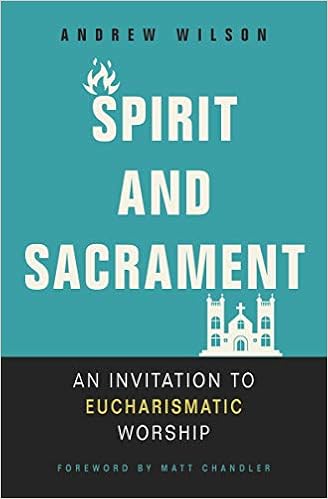
Andrew Wilson's Spirit and Sacrament review

Spirit and Sacrament: An Invitation to Eucharismatic Worship
Andrew Wilson


The most enjoyable book I've read this year. Clearly written by a preacher-scholar rather than a scholar alone, the rhetorical flourishes made this book a joy to read.

I really wanted to read Schreiner's and Wilson's book close to each other, and managed to fit both of them in within a week. They were both written concisely and clearly and with a view to a general audience, but without holding back from entering into serious discussion when warranted.

This book was an exhortation, or, as Wilson describes it, an invitation, to "eucharismatic worship"; essentially this means taking tradition and in particular the liturgy more seriously, but also zealously pursuing the spiritual gifts. These dual perspectives made for a more well-rounded book than Schreiner's, although it's a little unfair to compare as Schreiner had only one purpose (to make the case for cessationism). Nonetheless, by combining them, Wilson well made the point that the two aspects (liturgy + charismata) both have a history which we discard to our detriment. To be a historically faithful Christian is to celebrate all that is in the liturgy (at the forefront is the eucharist but also the elements of confession, thanksgiving, creeds and so on) but also to pursue and practice the spectacular spiritual gifts (my term) in continuity with NT Christianity as well as the early church.

As Schreiner said in his ETS paper published in Themelios, the very least a cessationist should take away from this book is the importance of the liturgy. But this is similarly a very good case for an historically rooted and orderly practiced charismata.

Apart from being a joy to read, the overwhelming impression was the generosity with which his view and the alternate views were presented. There was no point at which anyone was called anathema (although perhaps those who refuse to celebrate communion might be in danger of this!), but rather people of differing opinions and histories were reminded firstly of the primacy of our unity in Christ. I'm very thankful to have read this book and will continue to reflect on the implications.

Monday, July 22, 2019

Brief review of Schreiner's "Spiritual Gifts"


Spiritual Gifts

A few months ago there was an interesting discussion between Thomas Schreiner (cessationist) and Andrew Wilson (continuationist), which led to a debate and dominated a recent edition of Themelios. I ordered their books on spiritual gifts and wasn't sure which to read first, but Schreiner's arrived first, and I read most of it on a plane last week and finished it this morning (172pp with large font and lots of white space).

Here is my very brief review. I will probably have more to say once I've read Wilson's book.

Spiritual Gifts: What They Are and Why They Matter
by Thomas R. Schreiner


Good little primer on a case for cessationism. There were a few leaps of logic and I really wanted more detail at several key points, but overall it was not a bad book.

I disagreed with Schreiner's discussion on Acts 8, as I read the receipt of the Holy Spirit after their belief as the remarkable outward manifestation of the Spirit, not as indicating a lack of receipt in the first instance.

Similarly I was unsure why the discussion on the fallibility of prophecy was required and so long, but there must be a debate I'm unfamiliar with that he was entering into.

The irenic tone of the book was much appreciated and I look forward to reading Andrew Wilson's book next as a companion to this.

Wednesday, June 08, 2011

scripture sanctifies - stephen fowl

i'm still trying to work out what my project is about. it's still something to do with Paul Ricœur. and how we read the bible.

along the way i thought i'd share this gem from Stephen E. Fowl, who is obviously a fan of John Webster's 2003 Holy Scripture: A Dogmatic Sketch.

The Spirit's work in the operation of God's providential ordering of things sanctifies the means and processes that lead to the production of Scripture, turning them to God's holy purposes without diminishing their human, historical character. Thus, in calling Scripture "holy," Christians are not making a comprehensive claim about the purity of the motives of the writers and editors of Scripture. These may well have been decidedly unholy. Even in the face of such unholy motives and actions, Christians are committed to the belief that the triune God has revealed a passionate desire to have fellowship with them, even in the light of their manifest sin. Scripture is chief among God's providentially ordered gifts directed to bringing about reconciliation and fellowship with God despite human sin. Thus, Scripture is holy because of its divinely wiled role in making believers holy. [p12]
Stephen Fowl, Theological Interpretation of Scripture, Paternoster 2009.

i think i like the way the acknowledges potential historical-critical issues yet the importance of the Spirit. i'm not sure how far i'd agree with his 'decidedly unholy', but he could just be suggesting people didn't sit down with a view to writing 'Scripture'. which is surely true. but maybe (hopefully?) they did think they were writing true things about God?

Wednesday, July 29, 2009

Jesus in you

i haven't yet read a Greek Grammar textbook and said 'oh wow'. but i did say 'that's really interesting' after reading the section on the preposition Πρός (pros).* i've always assumed the idea of 'asking Jesus into your heart' was a Biblical idea, talking about what you do when you become a Christian.

it seems the place this comes from is Revelation 3:20 (hovering should show the verse). but what does it mean to come in to (not into), and to whom is Jesus talking to?

anyway, long story short, the people he's talking to are already Christians, who are being lukewarm in the way they're living out their lives. and εἰσελεύσομαι πρός (eiseleusomai pros [enter in]+[to]) always has the idea in the NT of coming in toward/before someone/thing.

so what we can say is that it's not an offer of salvation, but a consequence thereof. and i would want to say it's a 'being with' idea, not 'dwelling within' - the verse continues with a shared meal, which would otherwise be parasitic!!! it's about fellowship with Jesus.

i was going to finish off this post talking about the fact that the holy spirit is who does dwell within the heart of the believer - but the closest i can find is 1 Corinthians 6:19 and 2 Timothy 1:14, but even they are inconclusive - especially 2 Timothy which could just as well be translated 'among us' (ἐν ἡμιν - en hemin) whilst 1 Corinthians talks about the Holy Spirit being in 'the body' of 'youse' - part of the theme of the picture of a church being one body, with Christ as the head.

where do we get this idea of inhabitation? sci-fi?
where else in the bible???

i guess if anything, it puts the emphasis back on salvation being relational.


* pp380 in Daniel B. Wallace, Greek Grammar Beyond the Basics, Zondervan 1996

Wednesday, January 21, 2009

the authentic Jesus

up at nextgen (formerly known as KYLC), a week-long conference where leaders of youth and kids are taught and trained to be better able to teach the youth and kids they disciple about Jesus.

the morning talks have been on Jesus' discourse on the Spirit in John (14:22-17:26), and by Grant Retief (from RSA).

he said (on 16:12-15) that we ought to submit to the apostolic interpretation of the ministry of Jesus because the promised Holy Spirit will teach the disciples, he is the promised Spirit of Revelation.
Thus (and this is my thinking), what does this say to the quests for the historical Jesus? the reconstruction of his life apart from, or behind, the obviously slanted teaching in the gospels. that is, knowing there is a purpose (ie that - in John's words - that you may believe that Jesus is the Christ, the son of God, and that by believing, you may have life in his name), means that we're not getting a facts-only view of Jesus of Nazareth.
so is there a point in seeking to discover him apart from the gospels and epistles - finding the Jesus that is not portrayed through the filter of the paraclete?
what should we say to people with projects like John Carroll's The existential Jesus?

i'm really interested to find out - but i wonder why? am i dissatisfied with the Jesus revealed to me by the prophets by the Spirit? why do i have this insatiable desire to be able to picture Jesus banging away at an A-Frame* in Capernaum by the Sea of Tiberias?

* the word on the street is that Jesus wasn't so much a french-polisher or a cabinet maker, but a carpenter who builds houses. which a chippie friend of mind says says a lot about Jesus - not about the showy-heights of cabinet making, but the grunt work of foundation building. but that's exactly the kind of stuff i'm talking about - why do we want to know this stuff!

Sunday, December 07, 2008

Big Berkhof

i attended a preaching conference at SMBC a couple of years ago now - one of the best things (apart from the teaching of course) was that their library was doing a bit of a clean out.
so anyway, the Don recommended, out of his talk on Systematic Theology, both Big Berkhof and Little Louis. and i went down to the library sale and picked up Louis Berkhof's Manual of Christian Doctrine (Eerdmans: 1931, reprinted 1981) - ie Little Louis.
and i can honestly say that it's been one of my most helpful para-biblical books - it goes through the issues, through all facets of Christian Doctrine, but straightforwardly (whoever would have thought the difference between supra- and infra-lapsarianism would be made straightforward?!), as well as showing the varying views of different denominational traditions, where they stand and where the important and trivial differences are.

he is fair to both sides, happy to say when there is good justification for either, but also not backward in pointing out, in all humility, the flaws in flawed standpoints.

with my doctrine exam looming nearer, a few weeks ago i decided i needed to step up - and get my hands on Big Berkhof - or Louis Berkhof's Systematic Theology (Eerdmans: 1938, reprinted 1996), and found it here for only 17 bucks, WITH his 1932 Introduction to the Study of Systematic Theology in the one volume!

BARGAIN!!!*

it's pretty thrilling - great quotes, such as this on the Holy Spirit:
The Bible never deals with the doctrine of the Trinity as an abstract truth, but reveals the Trinitarian life in its various relations as a living reality, to a certain extent in connection with the works of creation and providence, but particularly in relation to the work of redemption. Its most fundamental revelation is given in facts rather than in words. (ST p85)


Big Berkhof is not a book you'll read cover to cover, but it's by far my most used reference book. well, it will be - after Little Louis!
there was a stack of them at West Ryde Koorong - you just need to step over the realised eschatology section, block out the 'jesus is my boyfriend' music, and wear sunscreen to shield yourself from the glare of the gold-plated 'the message' 'bibles'. jokes, of course!

*i just checked Amazon - they're flogging it for double, plus that's US dollars, so super expensive

Monday, December 01, 2008

Fruity Gifts

what is a gift? what is fruit?
the new testament tells us both of these are from the holy spirit.
they're both great things to have.
but what's the difference?

[T]he fruit of the Spirit is love, joy, peace, patience, kindness, goodness, faithfulness, gentleness, self-control. (Galatians 5:22-23)


so the fruit is these things. these are not some of the fruits, nor optional extras - these are both things we see in all who are new creations in Christ. a lack then of these things must require earnest repentance - for these are the very lifeblood of our spirit-enlivened lives.

what of gifts? - 1 Corinthians 12:
Now there are different gifts, but the same Spirit.

to one is given a message of wisdom through the Spirit,
to another, a message of knowledge by the same Spirit,
to another, faith by the same Spirit,
to another, gifts of healing by the one Spirit,
to another, the performing of miracles,
to another, prophecy,
to another, distinguishing between spirits,
to another, different kinds of languages,
to another, interpretation of languages.
But one and the same Spirit is active in all these, distributing to each one as He wills.
(4,8-11)
these are then all to each individually, each being gifted for a purpose.

as a Christian then, with regards to:
Fruit --> pursue as you would a great pearl (Matthew 13:44)
Gifts --> if you've been given them, use them for the building up of God's people.

there's more to be said on this (duh) but the distinction i thought (from my pastor at St Albans) was a really helpful one.


apologies (and thanks) to those who still bother looking at this blog - been soooo busy - exams were hectic. not sure how much i'll be on here in the next whilst...