A friend of mine is having trouble coming to terms with middle age. He is going bald, and realises that he will never again have hair like Michael Douglas had in “Streets of San Francisco”. He knows it is too easy to spot plugs and rugs. He realises that he will never achieve that great sporting moment he has been meaning to get around to for the last couple of decades (he was certain he still had a 3’15’’ marathon time left in him). Even if he did get around to doing the training, he would probably strain something. His body and mind simply cannot do what they used to do, seemingly, only a short time ago.
He’s done the maths and realises that he simply doesn’t have the years left on this earth, or the finances, to do all those things he has had his heart set on for longer than he can remember.
People who he regards as younger friends clearly regard him as elderly.
Then, last Christmas, his (wise) son bought him a book: “Men – firing through all of life” by Al Stewart, Bishop of Wollongong.
My friend has read a lot of self-help books (he needs all the help he can get), but this book is far and away the best book in terms of articulating the plight of middle-aged men. Not only does Al brilliantly define the situation of middle-aged men and outline the causes of their predicament, he also shows them a way forward. It is tremendously reassuring for my friend to realise not only that he is not alone, but also that there is a way to turn things around.
“Men – firing through all of life” by Al Stewart – what a great gift for a middle-aged man you may know.
Sunday, March 08, 2009
Men - Firing through all of life - a review
A guest post - by a budding writer - my dad!


Friday, March 06, 2009
Reformation
i was looking for a book on the reformation for church history 2.
typed it into a search engine and found up the top of the page this:
 coincidentally, just the one i'd been thinking about.
next but one was:
now i don't want to judge a book by it's cover, and, hey, you get free postage at fishpond for $50+ - so maybe i could just them to throw it in!
typed it into a search engine and found up the top of the page this:
 coincidentally, just the one i'd been thinking about.
next but one was:

now i don't want to judge a book by it's cover, and, hey, you get free postage at fishpond for $50+ - so maybe i could just them to throw it in!
Wednesday, March 04, 2009
Glory in Flesh
Bultmann, John, 63, observes:
(δοξα means glory; σαρξ flesh)
we do not need to deny the creaturely-ness of the logos, for indeed it is in his becoming human that we see a God reaching out, allowing himself to get bruised and dirtied in the process.
‘It is in his sheer humanity that he is the Revealer. True, his own also see his δοξα; indeed if it were not to be seen, there would be no grounds for speaking of revelation. But this is the paradox which runs through the whole gospel: the δοξα is not to be seen alongside the σαρξ nor though the σαρξ as through a window; it is to be seen in the σαρξ and nowhere else. If man wishes to see the δοξα then it is on the σαρξ that he must concentrate his attention without allowing himself to fall a victim to appearances. The revelation is present in a peculiar hiddenness’.Bultmann's reflections on John 1:14.
(δοξα means glory; σαρξ flesh)
we do not need to deny the creaturely-ness of the logos, for indeed it is in his becoming human that we see a God reaching out, allowing himself to get bruised and dirtied in the process.
Saturday, February 28, 2009
motorcy... cle
i've had this song in my head for a while now
by Arlo Guthrie - famous for
just as an aside, i had a squiz at his website - he wants his church to be on some Massachusetts state currency!
it just happens he's gone and bought the church that Alice used to live in (you remember Alice?) and, keeping the name 'Holy Trinity', has dedicated it to all those around the world who believe that there is one truth and infinite ways to approach it.
apparrently on the front door his guru has written,
never let it be said that there are any sentient beings Arlo doesn't care for.
i wonder how many orang-utans he gets coming thru...
(i still like his songs tho.)
by Arlo Guthrie - famous for
- being the son of Woody Guthrie,
and for - his 18 minute song Alice's Restaurant Massacree.
I don't want a picklethat's about it. he has an interesting story to explain the song, youtube clip here, one version of the 'verse' here.
Just want to ride on my motorsickle
And I don't want a tickle
'Cause I'd rather ride on my motorsickle
And I don't want to die
Just want to ride on my motorcy ...cle.
just as an aside, i had a squiz at his website - he wants his church to be on some Massachusetts state currency!
it just happens he's gone and bought the church that Alice used to live in (you remember Alice?) and, keeping the name 'Holy Trinity', has dedicated it to all those around the world who believe that there is one truth and infinite ways to approach it.
apparrently on the front door his guru has written,
One God - Many Formsthis church has been re-consecrated to the service for which it was originally intended - Service to God and to all sentient beings.
One River - Many Streams
One People - Many Faces
One Mother - Many Children
never let it be said that there are any sentient beings Arlo doesn't care for.
i wonder how many orang-utans he gets coming thru...
(i still like his songs tho.)
Sunday, February 22, 2009
MKC '09
heard a great quote up at Men's Katoomba Convention (also known as 'man-con') from former National Party leader, John Anderson. it was in response to the Humanist Society's advertising campaign (see also Faith and Theology herefor some alternate suggestions).
thanks for pointing that out Professor (of Botany, wasn't it?) Dawkins.
oh, and go to MKC - there are two weekends left to go - Al Stewart and Simon Manchester tag-team their way thru Daniel. it's great.
he's saying there's 'Probably' no God? as Australia's longest serving transport minister, what if i had told australians the planes 'Probably' won't crash! people would say - so you mean there's a chance they will?his point being, that the chance there probably isn't a God means there is a chance there is - and if there is a chance that there is a God, then we DEFINITELY need to find out to our 100% certainty whether there is.
(roughly paraphrased)
thanks for pointing that out Professor (of Botany, wasn't it?) Dawkins.
oh, and go to MKC - there are two weekends left to go - Al Stewart and Simon Manchester tag-team their way thru Daniel. it's great.
Friday, February 20, 2009
a wrestlin' wreview
mickey rourke - tick
blood - tick
really nice hand-held camera work - tick
some rockin' 80's music - tick
yes indeed, the wrestler was just the movie six red-blooded blokes needed to get ourselves down to on tight-arse-tuesday - and the cinema was packed!
please note - a date film this is not.
the big question this flick asked us all was, at the end of the day, what would you rather have?
- no passion, but a humdrum life of saturday night dinners with your over-emotional lesbian daughter and playing happy families with a worn-out stripper, or
- the roar of the crowds everytime you walk out - RAM, RAM, RAM, RAM, RAM, RAM...
when i paint it that way, it's not that hard to choose.
but the director Darren Aronofsky doesn't make it that easy for us. one amazing scene, we share in the exhilaration of the crowd as the Ram walks out of the ring victorious. the next thing we see, however, is the pain, the staple-gun injuries, the barbed-wire tears, the chunks of broken glass that ain't gonna come out easy - and we think - why? what for? what is the point of it all? just give it up - you might actually enjoy the warmth of family, the assuredness of knowing you have a regular income so you don't get locked out of your trailer by your landlord.
is it a question of degrees of highs? do you want the heights of ecstasy (with its accompanying lows), or a mid-range life? if you want the latter - go see Revolutionary Road. maybe Rourke did - that's why he is the wrestler.
i found this movie hard, but good. good, because i didn't want to see just any old film. (i don't know if any has ever hired Mighty Ducks out since they saw it on TV in the 90's.) because we all want to feel; sometimes it's nice to go thru the wringer of emotions - the 'cut yourself to see if your heart's still pumping' idea.
but at the end of the day, i still have to ask - what was his life for? what did he fight for? was the price he paid worth it?
what do you live for, fight for, strive for, sacrifice even your own body for? do you run 'the' good race, is whatever your life is being sacrificed for (poured out as a drink offering) what you want it to be spent upon? are you pursuing fleeting pleasures - living it up now - but haven't given the rest of your years - let alone eternity - a thought for some time?
don't waste your life.
ps a good chunk of this flick is in a strip-bar. you may wanna take that into consideration. find a spot, or something. forewarned and all that.
Thursday, February 19, 2009
Wood - Epistemology
all grown up now - finished my bridging assignment (with a respectable 'Pass' mind you), and into Philosophy 2.
set reading: Wood, W, Jay, Epistemology: Becoming Intellectually Virtuous. Leicester: Apollos, 1998.
some highlights from chapter 1:
i think it would be really easy to just 'do' philosophy - but this collection of quotes is reminding me that that is a dumb attitude. whether Christian or non-Christian, being intellectually lazy - not thinking about what you believe, why you believe, what what you believe means - isn't really an option. this isn't to say that everyone needs to or should nerd-up (as Wood helpfully notes), but we need to be thoughtful about what, why, and wherefore.
set reading: Wood, W, Jay, Epistemology: Becoming Intellectually Virtuous. Leicester: Apollos, 1998.
some highlights from chapter 1:
We achieve excellence in the intellectual life, according to this tradition, when we form within ourselves qualities like wisdom, prudence, understanding, intellectual humility, love of truth and similar traits—in short, as we embody intellectual virtues. Your intellectual life is important, according to [Aristotle, Augustine and Aquinas], for the simple reason that your very character, the kind of person you are and are becoming, is at stake. God cares about how you think, not just what you think. A godly mind is not merely one devoid of vile thoughts, nor are the faithful stewards of the mind necessarily the ones who die with all their doctrinal ps and qs in place (brainwashing might as effectively accomplish this). "The good of the intellect is truth," writes Aquinas, "and falsehood is its evil. Søren Kierkegaard stresses the importance of those truths that nourish the soul.
i think it would be really easy to just 'do' philosophy - but this collection of quotes is reminding me that that is a dumb attitude. whether Christian or non-Christian, being intellectually lazy - not thinking about what you believe, why you believe, what what you believe means - isn't really an option. this isn't to say that everyone needs to or should nerd-up (as Wood helpfully notes), but we need to be thoughtful about what, why, and wherefore.
Saturday, February 07, 2009
Für meine Deutsch sprechende leser!

Sprichst du Deutsch?
hier befindest du eine neue Bibelübersetzung!
bei den link aufgeschlagen ist Johannes 3, da wo der Pharisäer Nikodemus den Jesus fragt was es heißt, neu-geboren zu werden.
Jesus erklärt zu ihm,
16 Denn so sehr hat Gott diese Welt geliebt:
Er hat seinen einzigen Sohn hergegeben,
damit keiner verloren geht,
der an ihn glaubt.
Sondern damit er das ewige Leben erhält.
d.h.
17 Gott hat den Sohn nicht in diese Welt gesandt,
damit er sie verurteilt.
Vielmehr soll er diese Welt retten.
was anders ist mit dieser übersetzung (bis her nur die vier-Evangelien (d.h. Matthias, Markus, Lukas, Johannes)) ist, daß Die BasisBibel ist eine völlig neuartige Übersetzung der Bibel.
falls du mal mit der Luther Bibel versucht hast, kansst du verstehen wie wichtig es ist mit etwas lesbar anzufangen. hier, zum Beispiel, kannst du acht verschiedene Übersetzungen lesen (BasisBibel verbraucht der Gute-Nachricht-Bibel wo ihre übersetzung nicht erreicht.)
du kannst bei den BasisBibel Foren fragen stellen, du kannst auch dein Maus über den verblaute Wörte (d.h. schwierige wörte) laufen lassen, um eine kurze erklärung zu lesen.
falls du eine weile schon dich nichts vom Glauben gefragt, schau mal bei Basisbibel vorbei - und sag mir wie es dir gefallt!
h/t jesus.de
Friday, February 06, 2009
The Case for Crock?
i've just finished reading Lee Strobel's The Case for Easter for a webSalt review (which i'll publish here after they are happy with it).
in my reading for it, i went surfing to see what others thought of some of his experts. i enjoyed his Christ, but felt Faith was much weaker. i was then given Creator and was thoroughly unconvinced. sadly, it seems Strobel's journalistic gravitas has given way to his bias. time to hang up his quill, i suggest.
via Wikipedia i chanced upon infidels.org, a nonprofit educational organization dedicated to defending and promoting a naturalistic worldview on the Internet. with their bias clear, i could happily read the article responding to Creator, and i saw how low Strobel seems to have sunken.
not only is he far less selective about his experts, but he is happy to use anyone who will give his case credibility - definitely contraryto what his premise had been for all his books (hard-hitting investigative journalist, not taking anything for granted, asking the questions others never got to etc).
so Paul Doland quotes one of Strobel's experts, a Dr. Jonathan Wells,
although such bias may fit with Strobel's, it is by no means scholarly.
i'm not trying to have a go at the guy, i'm sure he's got great intentions. but there are times when what you set out to do isn't what you finish up doing. and you need to rethink things. you end up creating a god of the gaps, by only interviewing people who support your viewpoint.
in my reading for it, i went surfing to see what others thought of some of his experts. i enjoyed his Christ, but felt Faith was much weaker. i was then given Creator and was thoroughly unconvinced. sadly, it seems Strobel's journalistic gravitas has given way to his bias. time to hang up his quill, i suggest.
via Wikipedia i chanced upon infidels.org, a nonprofit educational organization dedicated to defending and promoting a naturalistic worldview on the Internet. with their bias clear, i could happily read the article responding to Creator, and i saw how low Strobel seems to have sunken.
not only is he far less selective about his experts, but he is happy to use anyone who will give his case credibility - definitely contraryto what his premise had been for all his books (hard-hitting investigative journalist, not taking anything for granted, asking the questions others never got to etc).
so Paul Doland quotes one of Strobel's experts, a Dr. Jonathan Wells,
Father's [Sun Myung Moon's] words, my studies, and my prayers convinced me that I should devote my life to destroying Darwinism, just as many of my fellow Unificationists had already devoted their lives to destroying Marxism. When Father chose me (along with about a dozen other seminary graduates) to enter a Ph.D. program in 1978, I welcomed the opportunity to prepare myself for battle.
although such bias may fit with Strobel's, it is by no means scholarly.
i'm not trying to have a go at the guy, i'm sure he's got great intentions. but there are times when what you set out to do isn't what you finish up doing. and you need to rethink things. you end up creating a god of the gaps, by only interviewing people who support your viewpoint.
Wednesday, January 28, 2009
Café Event Horizon approaching fast
‘Many years ago this was a thriving, happy planet – people, cities, shops, a normal world. Except that on the high streets of these cities there were slightly more shoe shops than one might have thought necessary. And slowly, insidiously, the numbers of these shoe shops were increasing. It’s a well known economic phenomenon but tragic to see it in operation, for the more shoe shops there were, the more shoes they had to make and the worse and more unwearable they became. And the worse they were to ewar, the more people had to buy to keep themselves shod, and the more the shops proliferated, until the whole economy of the place passed what I believe is termed the Shoe Event Horizon, and it became no longer economically possible to build anything other than shoe shops. Result – collapse, ruin and famine. Most of the population died out. Those few who had the right kind of genetic instability mutated into birds – you’ve seen one of them – who cursed their feet, cursed the ground, and vowed that none should walk on it again. Unhappy lot. Come, I must now take you to the Vortex.’
Douglas Adams, The Restaurant at the End of the Universe, in The Hitchhiker’s Guide to the Galaxy, A Trilogy in Four Parts. Pan Books: London. 1992 (first published individually in 1980), p200
Do you think Sydney (and possibly our entire world) is in danger of this happening – but with ... CAFÉS?
To illustrate – I was on Cockatoo Island on the weekend, where no-one lives, and only slightly more know of its existence, let alone that you can camp there overnight as we did. And there was not one, but two cafés there!
Is it just the allure of the legal drug caffeine, or do we really need so many cafés? Are they just replacing all the milk bars and sandwich shops which have all gone the way of platform sneakers? Or is this perhaps the true cause of the global economic collapse - way way way too many cafés!
Monday, January 26, 2009
Descartes, Descartes, ... I drink therefore I am.

5. Descartes and rationalism: How did Descartes seek to secure true knowledge?
Biographically, it seems the way Descartes started out on his philosophical journey was thinking – the story goes that he was loathe to rise early in the morning and it was only when this was accepted by one of his Jesuit tutors that was he able to spend his mornings not engaged in chores but meditating, or thinking.
What he arrived at after his many mornings spent in thought would later be known as the Cartesian method (from DesCartes). And what was his method? Quite simply – doubt everything! Then one could be free to establish true knowledge from the ground up. He did this not by doubting himself and all things out of existence, but indeed by proving his existence primarily in his doubting. For his doubting was if nothing else thinking, and as his famous dictum states, ‘cogito, ergo sum’, or, ‘I think, therefore I am’.
As the father of the rationalists, Descartes sought to reduce things to its base parts. This was part one of his method – the analysis, followed then by the synthesis – the rebuilding thereafter of the problem to get an understanding of the big picture. He saw this as not dissimilar to an architect building a house – starting first with digging the trenches, and working upwards from there.
He did see some things which were beyond breaking up, beyond doubt – although his only basis for those things was that there was a good God who would prevent these things from being deceptions. This God he proved by the ontological argument (the starting point being not dissimilar to Plato’s forms) – that if we can imagine any God, inferior as the idea may be, the idea shows that there must be something even greater – and that is greater (this idea not dissimilar to Islam’s ‘Allah Akbar’ – ‘God is greater’ (than anything you could imagine)).
this is part of a series. check here for others in this series.
Thursday, January 22, 2009
Gene Robinson prays for Obama - and you!
i noticed a while ago that Gene Robinson would be praying for Obama. i noted that Rick Warren prayed, but Robinson seems to have gotten little-to-no coverage. there may be some technical or even political reasons for this, but i wonder whether people see him as a bit passé now; whether we're just over the hype around the first 'openly' gay episcopalian (american anglican) bishop.
although i still don't get why one would want to be in the leadership - let alone a member - of a club whose rules you disagree with (he is, and he doesn't), it's possibly still worth a think about why he prayed what he prayed.
this transcript is from here, which also has a youtube vid of it. it was pretty blustery, and there was lots going on - i don't even think the big O had arrived yet - but i assume he read it from script. my brief thoughts:
who is this God of our many understandings? and what is the good of him? who is he/she/is? and is he/she it the real deal? is this God capable of dealing with sin? can i put my trust in this God not just for this life, but for eternity?
he prayed that we would be blessed with anger-- at discrimination, but apart from the many at home and abroad, [...] refugees and immigrants, women, people of color, i wonder apart from Robinson's own agenda (which i'm certain this prayer wasn't about), in the massive issues in this world of discrimination, genocide, false imprisonments, persecution of many Christians the world over, where the discrimination against gay, lesbian, bisexual and transgender people fits in the scale of things.
sure, there are some laws that are a bit silly that don't recognise concomitant relationships, both homosexual and platonic, but can you really compare the inconveniences of a disproportionately vocal group with the atrocities committed against millions?
i would love it if people praying in the name of Christ's church would also pray in his name (John 16:24 et al). just a little point. it'd be nice if he got an eye in.
although i still don't get why one would want to be in the leadership - let alone a member - of a club whose rules you disagree with (he is, and he doesn't), it's possibly still worth a think about why he prayed what he prayed.
O God of our many understandings, we pray that you will…
Bless us with tears-- for a world in which over a billion people exist on less than a dollar a day, where young women from many lands are beaten and raped for wanting an education, and thousands die daily from malnutrition, malaria, and AIDS.
Bless us with anger-- at discrimination, at home and abroad, against refugees and immigrants, women, people of color, gay, lesbian, bisexual and transgender people.
Bless us with discomfort – at the easy, simplistic “answers” we’ve preferred to hear from our politicians, instead of the truth, about ourselves and the world, which we need to face if we are going to rise to the challenges of the future.
Bless us with patience-- and the knowledge that none of what ails us will be “fixed” anytime soon, and the understanding that our new president is a human being, not a messiah.
Bless us with humility-- open to understanding that our own needs must always be balanced with those of the world.
Bless us with freedom from mere tolerance-- replacing it with a genuine respect and warm embrace of our differences, and an understanding that in our diversity, we are stronger.
Bless us with compassion and generosity-- remembering that every religion’s God judges us by the way we care for the most vulnerable in the human community, whether across town or across the world.
And God, we give you thanks for your child Barack, as he assumes the office of President of the United States.
Give him wisdom beyond his years, and inspire him with Lincoln’s reconciling leadership style, President Kennedy’s ability to enlist our best efforts, and Dr. King’s dream of a nation for ALL the people.
Give him a quiet heart, for our Ship of State needs a steady, calm captain in these times.
Give him stirring words, for we will need to be inspired and motivated to make the personal and common sacrifices necessary to facing the challenges ahead.
Make him color-blind, reminding him of his own words that under his leadership, there will be neither red nor blue states, but the United States.
Help him remember his own oppression as a minority, drawing on that experience of discrimination, that he might seek to change the lives of those who are still its victims.
Give him the strength to find family time and privacy, and help him remember that even though he is president, a father only gets one shot at his daughters’ childhoods.
And please, God, keep him safe. We know we ask too much of our presidents, and we’re asking FAR too much of this one. We know the risk he and his wife are taking for all of us, and we implore you, O good and great God, to keep him safe. Hold him in the palm of your hand-- that he might do the work we have called him to do, that he might find joy in this impossible calling, and that in the end, he might lead us as a nation to a place of integrity, prosperity and peace.
AMEN.
O God of our many understandings, we pray that you will…
Bless us with tears-- for a world in which over a billion people exist on less than a dollar a day, where young women from many lands are beaten and raped for wanting an education, and thousands die daily from malnutrition, malaria, and AIDS.
Bless us with anger-- at discrimination, at home and abroad, against refugees and immigrants, women, people of color, gay, lesbian, bisexual and transgender people.
Bless us with discomfort – at the easy, simplistic “answers” we’ve preferred to hear from our politicians, instead of the truth, about ourselves and the world, which we need to face if we are going to rise to the challenges of the future.
Bless us with patience-- and the knowledge that none of what ails us will be “fixed” anytime soon, and the understanding that our new president is a human being, not a messiah.
Bless us with humility-- open to understanding that our own needs must always be balanced with those of the world.
Bless us with freedom from mere tolerance-- replacing it with a genuine respect and warm embrace of our differences, and an understanding that in our diversity, we are stronger.
Bless us with compassion and generosity-- remembering that every religion’s God judges us by the way we care for the most vulnerable in the human community, whether across town or across the world.
And God, we give you thanks for your child Barack, as he assumes the office of President of the United States.
Give him wisdom beyond his years, and inspire him with Lincoln’s reconciling leadership style, President Kennedy’s ability to enlist our best efforts, and Dr. King’s dream of a nation for ALL the people.
Give him a quiet heart, for our Ship of State needs a steady, calm captain in these times.
Give him stirring words, for we will need to be inspired and motivated to make the personal and common sacrifices necessary to facing the challenges ahead.
Make him color-blind, reminding him of his own words that under his leadership, there will be neither red nor blue states, but the United States.
Help him remember his own oppression as a minority, drawing on that experience of discrimination, that he might seek to change the lives of those who are still its victims.
Give him the strength to find family time and privacy, and help him remember that even though he is president, a father only gets one shot at his daughters’ childhoods.
And please, God, keep him safe. We know we ask too much of our presidents, and we’re asking FAR too much of this one. We know the risk he and his wife are taking for all of us, and we implore you, O good and great God, to keep him safe. Hold him in the palm of your hand-- that he might do the work we have called him to do, that he might find joy in this impossible calling, and that in the end, he might lead us as a nation to a place of integrity, prosperity and peace.
AMEN.
this transcript is from here, which also has a youtube vid of it. it was pretty blustery, and there was lots going on - i don't even think the big O had arrived yet - but i assume he read it from script. my brief thoughts:
sure, there are some laws that are a bit silly that don't recognise concomitant relationships, both homosexual and platonic, but can you really compare the inconveniences of a disproportionately vocal group with the atrocities committed against millions?
Wednesday, January 21, 2009
the authentic Jesus
up at nextgen (formerly known as KYLC), a week-long conference where leaders of youth and kids are taught and trained to be better able to teach the youth and kids they disciple about Jesus.
the morning talks have been on Jesus' discourse on the Spirit in John (14:22-17:26), and by Grant Retief (from RSA).
he said (on 16:12-15) that we ought to submit to the apostolic interpretation of the ministry of Jesus because the promised Holy Spirit will teach the disciples, he is the promised Spirit of Revelation.
Thus (and this is my thinking), what does this say to the quests for the historical Jesus? the reconstruction of his life apart from, or behind, the obviously slanted teaching in the gospels. that is, knowing there is a purpose (ie that - in John's words - that you may believe that Jesus is the Christ, the son of God, and that by believing, you may have life in his name), means that we're not getting a facts-only view of Jesus of Nazareth.
so is there a point in seeking to discover him apart from the gospels and epistles - finding the Jesus that is not portrayed through the filter of the paraclete?
what should we say to people with projects like John Carroll's The existential Jesus?
i'm really interested to find out - but i wonder why? am i dissatisfied with the Jesus revealed to me by the prophets by the Spirit? why do i have this insatiable desire to be able to picture Jesus banging away at an A-Frame* in Capernaum by the Sea of Tiberias?
the morning talks have been on Jesus' discourse on the Spirit in John (14:22-17:26), and by Grant Retief (from RSA).
he said (on 16:12-15) that we ought to submit to the apostolic interpretation of the ministry of Jesus because the promised Holy Spirit will teach the disciples, he is the promised Spirit of Revelation.
Thus (and this is my thinking), what does this say to the quests for the historical Jesus? the reconstruction of his life apart from, or behind, the obviously slanted teaching in the gospels. that is, knowing there is a purpose (ie that - in John's words - that you may believe that Jesus is the Christ, the son of God, and that by believing, you may have life in his name), means that we're not getting a facts-only view of Jesus of Nazareth.
so is there a point in seeking to discover him apart from the gospels and epistles - finding the Jesus that is not portrayed through the filter of the paraclete?
what should we say to people with projects like John Carroll's The existential Jesus?
i'm really interested to find out - but i wonder why? am i dissatisfied with the Jesus revealed to me by the prophets by the Spirit? why do i have this insatiable desire to be able to picture Jesus banging away at an A-Frame* in Capernaum by the Sea of Tiberias?
* the word on the street is that Jesus wasn't so much a french-polisher or a cabinet maker, but a carpenter who builds houses. which a chippie friend of mind says says a lot about Jesus - not about the showy-heights of cabinet making, but the grunt work of foundation building. but that's exactly the kind of stuff i'm talking about - why do we want to know this stuff!
Monday, January 12, 2009
9. How do you solve a problem like Derrida?
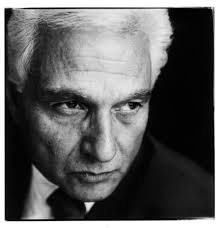
Derrida: Why does Derrida ‘deconstruct’ things?
Derrida was motivated primarily by political and ethical reasons. From a linguistic perspective he was interested in being aware of the histories and bases and implications of the language we use, for much of what we say can have meanings beyond what we may be aware of. He raised awareness of this by closely scrutinising the text to discover what else it may be saying. What may be seen as literal may indeed be a caged metaphor, with a whole world of meaning possible. And what may be discovered, at least this is his premise, is that within the thesis there is also the antithesis.
So when he looks at something such as forgiveness, he discovers a paradox: to forgive someone means that the deed was forgivable. But if that deed was forgivable, then it was hardly worth forgiving them in the first place. Rather, what truly deserves forgiveness is the truly unforgivable act. Yet this act is so heinous that it, by definition, is unforgivable. Uncovering such a paradox should then change the way we see something such as forgiveness – viewing the small forgiveness as but a picture of the big act that truly requires forgiveness.
Forgiveness and justice (and indeed his whole project), are ultimately impossible things. Yet they occur daily, and should be pursued, but must be more properly understood. For Derrida then, deconstruction is no idle task, for it reshapes our ethics, pulling them apart, like the reductionists of long ago, helping us see what is at the heart of them. His hope is then a real sincerity in the way we relate, and a decrease in dogmatism.
From my brief reading about Derrida, it seems that although unique, he was influenced by Kierkegaard, Roland Barthes, and even bears some semblance to the psychoanalysts.
It should also be noted that Derrida sees language as iteratible, that is, easily transplanted and ‘emic’ meaning thence lost. Thus there is no sanctity in language as such, the deconstructor is free to pull it apart as much as one will.
i should add, i've been reading On Cosmopolitanism and Forgiveness to help me think through this. more on that book in particular later
this is part of a series. check here for the others uploaded.
Wednesday, January 07, 2009
What about me?
chatting to my french neighbours tonight, one of whom went to what sounds like a pretty average bible study - they read the bible, discussed the passage, and prayed for one another. something that happens very similarly all over the world every day of the week.
but what struck this girl was the selfishness of the prayers - "help me with this exam", "help me with my sickness" and so on. pretty typical really.
so two questions i guess -
so then, on:
however, all this said, i still think my neighbour has a point - we can be selfish, and trivial, unreflective (non-reflective?), and ungrateful in our prayers. and regardless of the context and whatever and whenever else we may've prayed, the way we pray and the subjects of our prayers can say a lot about the motivations for praying, for meeting together, for attending church, for reading our bibles.
i would like to be one in whose spirit there is no deceit. (Psalm 32:2b)
but what struck this girl was the selfishness of the prayers - "help me with this exam", "help me with my sickness" and so on. pretty typical really.
so two questions i guess -
- is this just because we do all the 'big picture' praying at home on our own?
- is this actually an accurate reflection on many of the psalms' prayer patterns - hence worth echoing?
so then, on:
- i think probably not, although having operation world as your homepage (and actually praying about it), and/or getting the voice of the martyrs' rss feed can be big helps to praying for things of bigger import than your pet rock's well being.
and regarding: - many of them are selfish - in that they talk about themselves - YET they talk about themselves so as to talk about God. and there are plenty that talk only about God. and they're poems - of course they need some sort of perspective, and it makes sense to talk in the first person - have you ever been around someone who talks about themselves in the third person? very irritating indeed.
however, all this said, i still think my neighbour has a point - we can be selfish, and trivial, unreflective (non-reflective?), and ungrateful in our prayers. and regardless of the context and whatever and whenever else we may've prayed, the way we pray and the subjects of our prayers can say a lot about the motivations for praying, for meeting together, for attending church, for reading our bibles.
i would like to be one in whose spirit there is no deceit. (Psalm 32:2b)
Subscribe to:
Posts (Atom)