Showing posts with label books. Show all posts

Monday, October 18, 2021

Review: Achievement Addiction

 Justine Toh, Achievement Addiction (CPX/Acorn, 2021)


Since I first met Justine 15 years ago, I was impressed with her knowledge of pop-culture, be it written or screen. And it's nice to see nothing has changed. She brings her wide and deep reading to bear in this newest addition to CPX's Re:Considering series, in this easily digestible volume considering all things achievement related.

Chapter 1, Strive, was really a look inwards, at the Asian in all of us. This is something I've grown to understand, coming from possibly the whitest school in Australia (there were two non-white kids in my grade), to now living in Sydney, pastoring a Chinese church, and having to learn some Cantonese to speak to my in-laws. But what Toh demonstrates is the views stereotypical of Asians are values shared by many of in many ways. It's the constant push to succeed, to be driven and to drive your children. We are addicted to achievement because we valued, and value, by our status in society.

Chapter 2, Suffer, is about what we will put ourselves through in order to achieve, and to be seen to achieve. Toh talks about Fitbits, but it could as easily be my unbroken record of 400+ days of Duolingo until I went cold-turkey. Because suffering to achieve can become dislocated from what we are actually suffering for. So with a retelling of the plot of A Lonely Girl is a Dangerous Thing (or one might think of Herman Hesse's devastating Unterm Rad), the point is driven home, that to suffer to achieve can become a striving which can never reach its goal.

Chapter 3, Smug, pricked me the most. Growing up little, bookish and bullied, I sometimes wonder whether those who saw me as an easy target would think twice if they knew how far I've come academically. But of course they wouldn't; it's my smugness to think that I've achieved and they haven't and therefore I'm better than them. If life is divided into the haves and the have-nots, I can rest easy in my smugness. But of course, as Toh suggests, there is nothing virtuous about achieving: smugness makes one unwise, unkind, blind and prejudiced.

Chapter 4, Story Time, suggests a different way. Beginning with Eliza Hamilton's gracious forgiveness of the smug, unwise and unkind Alexander, we see in the one who said that "the first will be last and the last will be first," a different way of living and being and achieving. Rather than the equation "hard work + perseverance = rightly earned success", a life lived by grace, receiving as a gift, transforms how we are in the world. It enables true community (as suggested in O'Donovan's Common Objects of Love), so that achievement is not simplistically diminished, but "put in the service of others." (58)

Achievement Addiction is a charming and provocative read. Even if I missed the Harry Potter references, and had not heard "bougy" before, I thoroughly enjoyed and appreciated this book. I also have a few more books to read—just need to add them to my list and instagram a photo of how tall my to-be-read pile is growing...

Thursday, September 23, 2021

Review of Ecclesiastes, Song of Songs

GEORGE ATHAS, Ecclesiastes, Song of Songs (Grand Rapids, Mich.: Zondervan, 2020) pp 400. Hardcover. $45.23.


With Ecclesiastes, Song of Songs, George Athas provides his own contribution to the Story of God Bible Commentary series. Unique to this commentary is situating both Ecclesiastes and Song of Songs in the Greek era; the introductions explain why he believes Ecclesiastes was written under the hopelessness of the Ptolemaic occupation in the 220s BCE, and Song of Songs under the pressures of Hellenisation in the final days of the Seleucid occupation in the 160s BCE. The second part in each section, “Explain the Story”, both tackles important exegetical questions but also shows how the historical context shapes the text and our interpretation of it. 

Athas uses the introduction of Ecclesiastes as well as the “Listen to the Story” sections to spell out his suggestion of a Davidic descendant writing in the 220s under Ptolemaic rule in the context of the chief priest Onias II’s misjudged leveraging of the Seleucid kingdom and the devastating impacts that had on the Jewish people. Athas does not suggest an identity for Qohelet beyond a Davidic descendant, but suggests they were still aware of their royal blood and, while they were not a king, were things to have run differently they might well have been. They write as one who would be king according to God’s promise, yet with no hope of being king because of circumstance. This enables them to evaluate the foreign rulers and local leaders such as Onias and Joseph Tobias and to point out their many failures. The book’s hebel motto thus outweighs any provisional carpe diem statements as God has shown himself unwilling to intervene and help his people. 

The background to Song of Songs are the actions of Jason and Menelaus, along with Antiochus’s response in removing the special religious status of the Jews. The Solomon character represents pressures of Hellenisation, the shepherd boy Yhwh, and the woman Israel who desires to be loyal to Yhwh but is fighting a losing battle against Hellenisation. This historical specificity makes for an engaging reading of the Song as a story, situating it in a time and place of extreme pressures, and also explains the need for oblique allusions to refer to people, places and God. While not all interpreters will agree with this reading, Athas has set a new standard in suggesting and demonstrating the viability of quite a precise dating. 

When it comes to structure, I was disappointed that none of the recent advances in Ecclesiastes studies made any impression on this book (on this, see my own Seeing what Qohelet Saw). He makes brief mention of the frame, which Athas believes to be late, but in agreement with Qohelet. Otherwise he has essentially broken the book up into preaching units, suggesting instead that “[t]here is no clear literary seam between these stages. The whole movement gives a sense of uncontrolled, heavy descent into darkness and oblivion, capturing perfectly Qohelet’s sense of the fate of humanity and, more particularly, the Jewish nation.” (41) In Song of Songs he made a strong case for the different speakers throughout, but this didn’t noticeably impact the structure; the focus remained on the story. 

Evidently however, structure was not his concern; where this commentary breaks new ground is its consistent application of the historical specificity. Dating Ecclesiastes to the Ptolemaic era was foreshadowed in his 2019 Biblica article on 4:13–16, building on Barbour’s 2012 monograph, as well as Schunck’s 1959 article which suggested that it would be natural for details of the era to be hidden within the book. Athas demonstrates how an understanding of the key movers of the second half of the third century BC brings much more clarity to the otherwise ambiguous declarations and descriptions. To approach the book with such specificity is not one taken by any major commentary series I have yet come across, as most take the author and date to be unknowable beyond someone some vague time period within the second temple period, and this will be where future interaction to this book should come in response. What is unclear is whether the jury, who have essentially decided the date cannot be known, will be swayed to reconsider their agnosticism. That is, while this approach to dating seems plausible, the ambiguities and lack of any explicit referents in the text makes it doubtful whether this will be taken up beyond being referred to as a fascinating conjecture.

When it came to the “Live the Story” sections of Ecclesiastes, a dichotomy was drawn between “Qohelet liv[ing] in a ‘BC’ world” (162), and us who “live in an ‘AD’ world” (193). Now, of course this is true, but the way it was emphasised does raise some important canonical questions of what it means to read Scripture on its own terms. Again, this is not to say Christians cannot or should not read the Old Testament through the lens of Jesus, but to draw a distinction in the way Athas has diminishes the testimony of Ecclesiastes on its own. According to this pessimistic reading, Qohelet affirms that life truly is meaningless, but Jesus tells him he is wrong. The way Athas squares this circle is to insist that Qohelet views the world under the sun, whereas Jesus views the world under the heavens (under the heavens being the viewpoint only available to God); Qohelet’s view is provisional, Jesus’ is complete. If we met Qohelet today, “we might wish to point [him] to Jesus” (193). All that being said, this book is unashamedly a Christian reading of Scripture, and demonstrates one way to do so for those (probably the majority) who do read Ecclesiastes pessimistically. 

This new commentary is essential reading for anyone studying Ecclesiastes or Song of Songs as it presents and shows in practice what it looks like to read these books as from a specific time and place; Athas’s wonderful storytelling throughout reveals both Ecclesiastes and Song of Songs to be telling consistent and coherent stories. Reading this book should be an encouragement to all readers to open up Ecclesiastes and Song of Songs again and with fresh eyes.  

Saturday, October 17, 2020

Errata

 As I've been going through Ecclesiastes again, I noticed an error in my book. 

On p50 I wrote: 

"in 4:1 there is a fourfold use of עשׁק (to oppress), which occurs four times as a participle, albeit in different forms each time,"

It's clearly only thrice. In trying to understand why I made this error, I think I must have misread נַעֲשִׂים (from עשה) as הָעֲשֻׁקִים (from עשק). It's also possible that my brain was looking for groups of four - in the same paragraph I discuss 4:4 and "four near-synonyms for work." 

If you want to fix it, perhaps the paragraph should read,

This similar formula is seen with את־כל (twice in 4:4), and then patterns of three: in 4:1 there is a triple use of עשׁק (to oppress), which occurs three times as a participle, albeit in different forms each time, while in 4:4 the pattern of three is made up of three synonyms for work, with מעשׂה, ,כשׁרון ,עמל as well as, for a potential fourth, what Qohelet describes as work’s functional equivalent, namely כי הוא קנאת־אישׁ מרעהו (for this is one’s envy over their friend).

I'm not sure how it got through so many readings and readers, but there you go. I also still need to track down the library copy of my MTh and fix a separate typo there (which thankfully I caught before the published version). 

Saturday, July 25, 2020

Book Review: Matthias Henze, Mind the Gap


Matthias Henze, Mind the Gap: How the Jewish Writings Between the Old and New Testament Help Us Understand Jesus, Fortress Press, Minneapolis, 2017. 235pp. $60.

---

Matthias Henze (Rice University) has written this very accessible introduction to Second Temple literature in order to help readers of the New Testament be mindful of the gap between the Old and New Testaments. It is very much an introduction, as there is not a single footnote (or endnote), although there is appendix listing suggestions for further reading. As such, then, this book cannot be the only thing one reads on the topic, but the approach is a useful primer.

As is appropriate for the readership, it is not a long book, and is divided unequally into two halves. The first is a brief but broad introduction to the Old Testament and the literature which was familiar to ancient readers, in particular the Dead Sea Scrolls, the Septuagint, 1 Enoch and 2 Baruch/4 Ezra (this last one was the subject of scholarly work he co-authored). The reason for introducing us to these is clear: Jesus "is concerned about messianic expectations, he expels demons, he expounds the Torah in conversation with the Pharisees, he preaches about the end of time, he looks forward to the resurrection of the dead, and he discusses life after death with the Sadducees." (p34) These topics are familiar to us from the Gospels, but there is scant to no cognisance of these in the Old Testament. To understand where these topics—familiar to the Jews of Jesus' time—have come from, the Old Testament will be of limited value. 

Rather than the "four hundred years of silence", as it is often declared in churches, the three or so centuries before the writing of the New Testament was a fertile time, where scriptural interpretation took place and new literary genres were created, such as "the Tales of the Diaspora (Daniel 1-6; Esther) and the apocalypse (Daniel 7-12; 1 Enoch; 2 Baruch; 4 Ezra)." (p50) This viewpoint is an important one, well known in academia, but almost never discussed in churches. Rather, in part due to the Greek and Protestant ordering of Bibles, the Old Testament is shown as finishing with the last words of Malachi, followed by centuries of silence, and then Jesus arriving right on cue. Henze attributes this false view not just to the ordering of Bibles, but also to the prejudiced term Spätjudentum (late Judaism). In his estimation, this term implies that Judaism was on its last legs, and, had Jesus not arrived, would have died out. In contrast, Henze's purpose is to show the "vibrancy and show its unique significance in the history of Judaism." (50) 

The far larger second half of the book (at three times the length) hones in on four topics which are central in the Gospels but seem to come out of nowhere from a reading only of the Old Testament. They are messianism, demons, the law and eschatology. In each chapter the topic as encountered in the Gospels is sketched, what Old Testament background there is is described, but also its insufficiency for understanding the Gospels; thirdly the appropriate second temple literature is detailed, and finally he describes the fuller picture arrived at after this survey.

The first chapter of the second half is entitled "Jesus, the Messiah of Israel," where Henze works through Psalm 2, Isaiah 11 and Daniel 7. His argument is that there is no actual expectation of a future messiah in these passages; it is only the Second Temple literature which repurposed these passages to express the hope in a future messiah. His argument is a subtle one, and perhaps not the best chapter to begin this second half of the book with. His point is that while these passages could be speaking of a future messiah, they weren't explicitly thought of doing so until this later period. To this he adds Psalm 146 and Isaiah 61 to show that, in the first instance, the blessings are not associated with a messiah at all, and in the second, that the servant is no longer understood generally or in a preterist way, but in a future messianic way. This then explains how Jesus quoting Isaiah in the synagogue in Luke 4 completed the expectations of the crowd, rather than introducing a completely new understanding of Isaiah's servant. For me, this is an exegetical hypothesis about what it might for the crowds to be "amazed" (Lk 4:22) rather than an open-and-shut case. Yes, there was a heightened expectation of a future messiah in this period, but the amazement of the crowd could just as easily be due to the interpretation as to his self-identifying, but this is a case Henze needs to argue, not just state. 

He then moves on to discuss the phrase "Son of God" and the "Son of the Most High," and this was a much more productive discussion. The expectations we are aware of from Qumran and the expectations from Luke 1:26-35, both use the same vocabulary and explain where the language comes from, which we would otherwise be ignorant of from just the Old Testament. He explains that "there is nothing arbitrary about Luke's choice of words and that his characterisation of Jesus is carefully chosen to answer the Jewish messianic expectations of his time." (81)

The second chapter, "In a World of Demons and Unclean Spirits," has a difficult task: explaining the origin of demons, and their corollary, exorcism. His first point is that the unclean spirits we meet in the New Testament have no background in the Old Testament. There are evil spirits and lying spirits, but they seem to be doing something very different and rather than being against God, are sent by God. Henze then proceeds to lead us through Genesis 6:1-4 (MT), then Genesis 6:1-4 (LXX), then the Book of the Watchers (1 Enoch) and the book of Jubilees, in order to explain the state of affairs we encounter in the New Testament. With another Qumran text (4Q510 I, 1-9) he shows us their hope that God will scatter them, and also gives us language used in Ephesians 5:8 and 1 Thessalonians 5:5 to describe oneself as "the sons of light" in contradistinction to the evil spirits who cause havoc in the world. I found this chapter much more convincing and genuinely useful for understanding the origin of the world-view that caused people to come to Jesus for cleansing. It is easy to dismiss the link between Judaism and the world of evil spirits, but this chapter explains that there is indeed a link, albeit via several texts, which, together, make clear how it all fits together.

The third chapter of the second half moves on the vexed topic of the place of the law, with the question, "Did Jesus Abolish the Law of Moses?" His target here is antinomianism and the mischaracterisation of the Pharisees, so he understandably wants to establish what understanding of the law was actually held during the New Testament era. In essence Henze wants to demonstrate the development of "Torah as law" to "Torah as wisdom." I was expecting a little more from this chapter, but he had more or less proved his argument from Psalm 1 and 119, which made the other material more or less redundant. There was one Qumran scroll, 4QBeatitudes, which, when coupled with Sirach, showed how the concept of Torah as wisdom was fairly well understood at that time. In summary, the logic is that for Josiah Torah was a legal code, for Ezra Torah was divine teaching, for Ben Sira Torah was wisdom, and for Paul that wisdom was Jesus. So far, so good. 

But at this point Henze seemed to get a little distracted. Although we know the golden rule from Leviticus (19:18), for some reason Henze seemed to think we needed proof that the golden rule was not a new thing, and therefore quotes Rabbi Hillel's non-malfeasance (do no harm) to show that Jesus fitted squarely within Judaism. This was unnecessary - even a misstep - but the reason became clearer when moving on to Paul and Romans 9-11. Again, this chapter is supposed to be about showing how the New Testament treatment of the Law fits within its context as elucidated from this gap-filling literature of which he is an expert. But instead, His argument descends into a comical exposition of universalism - not because there is no argument to be made - people are welcome to do so - but because this is a non-academic book, which does not interact with scholarship, and is supposed to be about something else. In the end, this chapter ends up being an apology for a two-paths model of salvation, Torah as wisdom for the Jew, and Torah as Jesus for the Gentile. This is all the more surprising as he even quotes the sectarian Damascus Document and refers to 4QMMT, both of which he explains as pushing the argument that they alone understand the law correctly and represent God's chosen people. To then argue for a two-paths salvation model seems incredibly anachronistic. He returns to this point in the epilogue, again quoting Romans 11, advocating people get involved in interfaith movements. It was an odd note to end the book on, and on reading one cannot help the feeling that this says more about him as a German living in America who is trying to come to grips with the Holocaust (which he mentions on the first and the third-last pages) and anti-Semitism, than it does about the documents he is purportedly trying to educate his reader about.

The final thematic chapter examines perhaps the most important missing link between the Old and New Testaments, "The Resurrection of the Dead and Life in the Company of Angels." Henze traces the thread which is seen in Isaiah and Ezekiel, speaking of national "resurrection", and places Daniel in a Second Temple context which is willing to speak more confidently of the resurrection of individuals. The views reflected in the words of Herod (John, whom I beheaded, has been raised, Mark 6:16) and Martha (I know that he will rise again in the resurrection on the last day, John 11:24) are placed in a context which includes Daniel from within the Bible, 2 Maccabees from the Apocrypha. The Psalms of Solomon show a hope for some form of life and judgement after death, while 1 Enoch 51 and 4 Ezra (late 1st century AD texts) link the resurrection for the righteous with the coming of "my Chosen One," who will appear after the resurrection to rule and judge. While those texts would make good conversation partners for Revelation and 1 Thessalonians, the next text, 2 Baruch, is selected to engage with 1 Corinthians 15, as the continuity between bodies now and resurrected bodies is discussed in these texts composed perhaps within 20 years of each other. Snippets of Qumran texts are mentioned to show a diversity of opinions which existed and discussions which were occurring about the realities of resurrection and who might expect to be resurrected and what the resurrected life would look like. 

This chapter probably offered the deepest dive into texts many are unfamiliar with. Although there are numerous hints in the Old Testament that resurrection is within God's power, these texts show how the belief moved from possibility to expectation. I did however feel there were a few missteps in this chapter. 1 Enoch 104 (p159) did not seem to be saying what Henze said it said, which was resurrection hope, although it seemed to be more a welcome into heaven. And when discussing Herod and Lazarus, he said, "Neither of these two passages ... is about Jesus," (p150), which is a remarkable statement. Perhaps one could argue that for the Herod/John the Baptist incident, although Mark's intent was more than just updating political goings-on. But the application of this comment to John 11 is simply wrong - it is all about Jesus, who deliberately delays coming (Henze thinks it took four days to hear and travel, p149) in order to reveal the glory of God (John 11:4). Henze's approach seems a little reductionistic, as if John 11 is there to illustrate first century AD Jewish views about resurrection. All that being said, this chapter was a gateway into this topic, and would be a great starting point for finding those Second Temple texts which illuminate the development of the understanding of resurrection. 

In the epilogue Henze answers three controversial statements he commonly has to defend, namely, that Jesus was not a Christian (he was a Jew), that these texts were important and familiar to the writers of the New Testament (who mostly quoted the Old Testament), and that the Bible is part of a literary world which helps us understand the New Testament. The discussion around these questions is the most rhetorically powerful part of this book, although presumably also the most practised. He makes a point that the unearthing of the ancient Near East was a powerful time for Old Testament studies, and has reshaped the way we understand and evaluate much of the Old Testament. It is thus important that we let these texts do the same for the study of the New Testament; that we bring the Dead Sea Scrolls and Apocrypha and other texts into conversation with the texts which comprise the New Testament.

For the price-point of this book ($60AUD at time of this review, for 200 pages plus a suggested reading list, glossary and two indices), one would expect a more serious work. Yet there are no footnotes, no interaction with differing opinions, and discussions of a topic are limited to two or three texts. This book reads as a series of introductory lectures but is priced at a point which implies a more rigorous book, which will disappoint readers (such as myself) who hoped for a little more value for money. If it were not the middle of a pandemic at time of writing, I would recommend students borrow it from the library, but for those interested in something more rigorous they will have to look elsewhere. Nonetheless it was mostly enjoyable to read, so it functions well as an introduction to the topic, but beyond that it will leave people wanting something a little more meaty. Perhaps George Athas's forthcoming Bridging the Testaments will be more helpful in this regard.


Two small notes: 
  1. Typographical errors: the word "of" is missing on p143, the word "had" is duplicated on p175, and there is an "s" missing from the "Index of Ancient Text [sic]" (p229).
  2. The lack of footnotes, endnotes, or bibliography, is paralleled with the absence of appropriate citations. Although translations of the Dead Sea Scrolls are cited in text (with a name only, but no date or publication), nowhere is the biblical translation appropriately cited (normally this would be noted in the front matter with appropriate copyright information). At one point, at one of the quotations of Sirach, the NRSV translation is mentioned, which appears to be the translation used throughout, but that was the exception rather than the rule.



Saturday, December 21, 2019

Seeing What Qohelet Saw - Published

Wipf and Stock have been kind enough to publish my revised Master's Thesis on the structure of Ecclesiastes. (I detailed the process here.) You can even pay them lots of money for your very own copy! Here is the link.
I've enjoyed the process of re-reading it several times and think it still holds up as an argument for my my structure of alternating panels of observation and wisdom based around the verb ראה (to see). Here's a pretty PDF of the structure if you're interested in the big picture. The more detailed one is within the book (well, it sort of is the book).

It was especially nice to see a few friends write endorsements for the book:
“Anyone who reads Ecclesiastes finds it hard to discern a clear structure. Amid the tangle of proposed structures, Fyfe outlines a way forward. He argues cogently for alternating observation and wisdom panes, with ‘to see’ marking out the former. Highly recommended for those interested in Ecclesiastes and the structure of biblical books.”
—Peter Lau, Visiting Lecturer in Old Testament, Sydney Missionary and Bible College
Peter has been published a number of times on the book of Ruth (most notably in the NSBT series), and after teaching in Malaysia for a number of years has recently returned to Sydney. He even preached for me recently!
“Like Qohelet himself, Fyfe reports what he has seen. His acute observation of the Hebrew text exposes the rhythms and artistry of Ecclesiastes. In doing so, he clarifies the meaning of this elusive book. Scholars and preachers should read this study and be stimulated ‘to find words of delight’ in the wisdom of the Preacher.”
—Richard J. Gibson, Principal, Brisbane School of Theology
Richard first nurtured my love of patterns in the Bible, and his work on the structure Romans bears many similarities to my structure of Ecclesiastes.
“Fyfe ventures into the enigma of Qohelet’s thought and seeks to wrest a structure from the murkiness of the ancient sage’s rambling. Fyfe argues for a deliberate pattern of alternating observation and wisdom, such that there may indeed be meaning within the apparent meaningless of Qohelet’s monologue.”
—George Athas, Director of Research, Moore College
George supervised my thesis, and is also about to publish a commentary on Ecclesiastes (in the Story of God commentary series).

In the next couple of weeks the book should come out through the well-known trillion dollar multi-national seller and e-book publisher. I should also be able to purchase some copies at author's rates if you'd like a copy at mate's rates - I can even not sign it for you if you'd like a clean-skin.

Friday, November 15, 2019

A timeline of getting a book published

In a couple of months there should be a book by me on the structure of Ecclesiastes that you can buy. It will have the same title as my Masters thesis:
Seeing what Qohelet Saw

the structure of Ecclesiastes as alternating panels of observation and wisdom.
I was thinking about how to explain the process of going from zero book to book. In some ways it could go back to my undergrad B.Div (2008-2011) at Moore Theological College, and the foundation that gave me in critical thinking and biblical languages. But I remember before that hearing the book preached at church, and reading Barry Webb's Five Festal Garments, where he works through the megillot, including Ecclesiastes. I remember really enjoying it as my first biblical studies book.

Fast forward to 2016 where I preached through the book at church. As with every series, the first thing I needed to get clear was the structure, and realising (a) that no one agreed on a structure of the book, and (b) that I thought I had seen something no one else had identified, pursuing this for a MTh seemed like a thing to do.

My initial proposal looked nothing like what it ended up as; initially it was looking at the different genres present in Ecclesiastes as revealed by my structure (narrative, poetry, wisdom, the frame narrator) and allowing figures from the past to shape our reading of the book (Lacoque/Ricoeur, Alter, Kierkegaard, Aristotle). The thought was I'd quickly knock the structure out, and then spend more time doing thinking and interacting. It didn't take too long before the structure alone would be more than enough to keep me busy for three years.

Anyway, I applied, was accepted, and started pretty much straight away. I worked very sporadically on it for the first year and a half, which included my supervisor having his long service leave and sabbatical, with another supervisor taking over during that time. So after about a year's break we met again and then I realised I needed to crack on. Rather than occasional days here and there, I asked for and was assigned a desk at college, and spent a day per week getting it done.

Towards the end of the second year, there was a Fellowship of Biblical Studies conference, which I presented my findings at, in a "panel from hell" - a PhD student also presenting on structure, and another author who I'd read and disagreed with. I was a bit worried about how it would go, but in the end it was actually a great experience. The PhD student was actually focussed on another area in Ecclesiastes; structure was just a side project. And after we'd both presented it was fairly evident that he didn't have that much invested in that part of it. The other speaker was actually really nice in person (even though he can be quite acerbic in writing!), and was only encouraging.

It was during the conference that I was again asked to consider converting the Masters to a Doctorate (both supervisors had suggested as much), but after a chat with the USyd head of department (who was very keen), I did some thinking and decided I just didn't have that much left in the topic beyond the 40,000 words required, to double it to PhD length. So at that point I pretty much drove hard to the end, and submitted before the beginning of the 2019 academic year, mostly so that I wouldn't have to pay for a 6th semester!

I had two examiners. One loved it, but seemed to want a little more convincing. The other had pages of things to be fixed (90% because he was used to a different footnoting style; nothing substantial), but nonetheless was very positive about my conclusions. So that was all good - graduation next year!

The next question was what to do with it now. I asked my supervisor which journal to submit to, and he thought for a minute, and then said, "nah, I reckon you should do a book." His point was to cut a 40,000 word argument down to 8,000 or so for a journal would lose a lot. But it would be fine for a smaller book, and would be perfect for people trying to think seriously through the structure of Ecclesiastes.

With his commendation attached, I emailed two publishers in June, 2019. It probably took 8 weeks to get responses (late August). One (Bloomsbury, for their LHBSOT series) wanted PhD level or above, but Wipf & Stock were happy to get on board, I think mostly due to their different publishing model and ability to do small print runs which means they don't risk quite as much as some other publishers. As the author you have to bear some of the costs before it gets to print. There are a lot of surveys to fill out (with both of them), mostly with regards to marketing and potential endorsements. They're as much for me as for them, to ensure that I know what needs to happen if I ever want it to go somewhere.

As we speak (November 2019), the book has been copyedited, and is being typeset, after which I will have to go through the proofs and then it can be printed and hopefully come to a bookshelf and/or library near you. The day when I can actually hold my book in my hand still a ways off, but it's been mostly a good process (although the wait after submission is always stressful). It hasn't been cheap, costing me more than $10 a page, and I doubt I'll ever make that back, but if libraries pick it up then at least people will be able to use it and benefit from it.

Ultimately my prayer is that people who want to think through the structure of Ecclesiastes will find my book accessible and useful. I do hope they will agree with me, but at the very least I hope they see the possibilities in my structure, and might try reading Ecclesiastes afresh according to my structure.

Ecclesiastes is a difficult book to understand, but it need not be impenetrable due to a lack of structure. With my structure, it opens itself up in a new way, such that people can consider its contents and message afresh. Well, that's my hope at least. Stay tuned for the day when you can actually get your hands on it too!

Friday, July 26, 2019

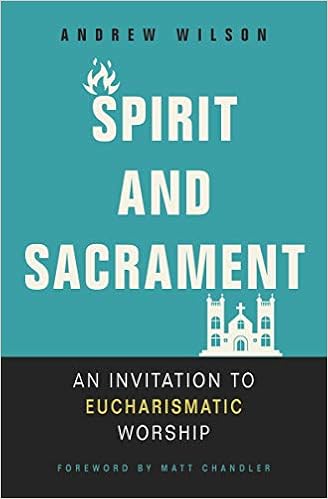
Andrew Wilson's Spirit and Sacrament review

Spirit and Sacrament: An Invitation to Eucharismatic Worship
Andrew Wilson


The most enjoyable book I've read this year. Clearly written by a preacher-scholar rather than a scholar alone, the rhetorical flourishes made this book a joy to read.

I really wanted to read Schreiner's and Wilson's book close to each other, and managed to fit both of them in within a week. They were both written concisely and clearly and with a view to a general audience, but without holding back from entering into serious discussion when warranted.

This book was an exhortation, or, as Wilson describes it, an invitation, to "eucharismatic worship"; essentially this means taking tradition and in particular the liturgy more seriously, but also zealously pursuing the spiritual gifts. These dual perspectives made for a more well-rounded book than Schreiner's, although it's a little unfair to compare as Schreiner had only one purpose (to make the case for cessationism). Nonetheless, by combining them, Wilson well made the point that the two aspects (liturgy + charismata) both have a history which we discard to our detriment. To be a historically faithful Christian is to celebrate all that is in the liturgy (at the forefront is the eucharist but also the elements of confession, thanksgiving, creeds and so on) but also to pursue and practice the spectacular spiritual gifts (my term) in continuity with NT Christianity as well as the early church.

As Schreiner said in his ETS paper published in Themelios, the very least a cessationist should take away from this book is the importance of the liturgy. But this is similarly a very good case for an historically rooted and orderly practiced charismata.

Apart from being a joy to read, the overwhelming impression was the generosity with which his view and the alternate views were presented. There was no point at which anyone was called anathema (although perhaps those who refuse to celebrate communion might be in danger of this!), but rather people of differing opinions and histories were reminded firstly of the primacy of our unity in Christ. I'm very thankful to have read this book and will continue to reflect on the implications.

Monday, July 22, 2019

Brief review of Schreiner's "Spiritual Gifts"


Spiritual Gifts

A few months ago there was an interesting discussion between Thomas Schreiner (cessationist) and Andrew Wilson (continuationist), which led to a debate and dominated a recent edition of Themelios. I ordered their books on spiritual gifts and wasn't sure which to read first, but Schreiner's arrived first, and I read most of it on a plane last week and finished it this morning (172pp with large font and lots of white space).

Here is my very brief review. I will probably have more to say once I've read Wilson's book.

Spiritual Gifts: What They Are and Why They Matter
by Thomas R. Schreiner


Good little primer on a case for cessationism. There were a few leaps of logic and I really wanted more detail at several key points, but overall it was not a bad book.

I disagreed with Schreiner's discussion on Acts 8, as I read the receipt of the Holy Spirit after their belief as the remarkable outward manifestation of the Spirit, not as indicating a lack of receipt in the first instance.

Similarly I was unsure why the discussion on the fallibility of prophecy was required and so long, but there must be a debate I'm unfamiliar with that he was entering into.

The irenic tone of the book was much appreciated and I look forward to reading Andrew Wilson's book next as a companion to this.

Wednesday, July 21, 2010

Hudson Taylor :: A Man in Christ

i've been busy (you may've guessed that from the lack of posts this last month). i've just finished an essay on Ezekiel and Regeneration, which i would like to talk about at some stage. but for the moment, here's a book review of a book i read a couple of months ago, which will appear at some stage on the webzine of AFES - websalt. check out their site for some really great and current reviews and articles.

Roger Steer. J. Hudson Taylor. A Man in Christ. Carlisle: Paternoster Lifestyle and OMF Publishing, 2001. 372p.

The name of Hudson Taylor is synonymous for many with Christianity in China. A man used mightily by God, this book traces his life in 48 bite-sized chapters, from his youth in England to his missionary work in China. On the way, you see God powerfully at work through a fallible man – but you also get the love story (stories!) and an enthralling picture of perseverance too – as you journey with him.

The first thing you learn is about Taylor’s parents, they always had a deep love for China and for the millions who didn’t know the love of Jesus. They always prayed for him that God would use him to reach China’s Millions.[1] However he didn’t share this vision until after his conversion at 17 through the persistent prayers of his family. This is a great story of the power of persistent of prayer, a theme returned to often in this biography.

There are some other themes we come across in the formative years of Taylor’s life, one his agonising over whether to finish his medical training before heading off to the mission field, but also his determination to ask no one for money. Both of these are still live issues for many, the first for anyone trying to work out whether to pursue full-time paid ministry. The second is a question for those in ministry, as they consider asking for financial support. Reading biographies of people like Taylor, but also Brother Andrew[2] and others, the way God provides exactly the amount required – even for the most sceptical – is really challenging.

In China, Hudson had a phenomenal impact. He taught himself to read Chinese whilst still in England, and quickly became proficient in many languages and dialects. His time was rarely trouble free, with disagreements with some missionaries and his incompetent sending mission organisation, as well his chronic sicknesses, deaths of those around him, war, persecution and betrayal. He did have great joy in seeing many be converted and mature in faith. He founded a mission organisation, the CIM (now OMF), and saw his audacious prayers for many co-workers answered.

When you read this biography, you don’t get the picture of a superhuman. You do get the picture of a workaholic, and give thanks for those around him who made him rest. You also see a frail man, yet a man continuing to live the Christian life day by day, reading his bible and praying to the God in whom he put all his trust.

I don’t know if you get in to Christian biographies. I always feel a bit sceptical, wondering if they really did all that, and particularly what the biographer chose to leave out. You end up siding with Taylor in any dispute, the only failure I can think of is when he’s quite old and gets a bit lost in a talk – which happens to the best of us regardless of age! But that said, the book does seem to be really well researched, from personal letters, other biographies, and I guess any filing cabinets around the OMF offices – and is still crafted into a riveting story.

Reading this biography of the great Hudson Taylor is really rewarding – I tried to read it one chapter a night before bed, and often read many more. You really feel his deep love for the unreached people of China,[3] and understood his absolute determination in going where reason should have deterred him. But the self-sacrificial love of Christ compelled him to go where no one else would. I would recommend getting into this biography, and to pray with him for the many unreached people throughout China, East Asia, and the world.

[1] the title of Hudson’s magazine, now called East Asia’s Millions.
[2] God’s Smuggler, London : Hodder and Stoughton, 1968.
[3] CIM stands for China Inland Mission – until Taylor, missionaries rarely ventured far from the main coastal cities.

i think you can buy it from OMF or perhaps here and support a great missionary agency at the same time!

Wednesday, May 19, 2010

the catechist

so i haven't blogged.
but i have been doing stuff.
this is one:

the catechist was published online earlier this month. i wrote an article for it: a book review of Miroslav Volf'sExcusion and Embrace.
the book is great. hard work but great.
briefly, it's thinking about reconciliation and forgiveness.

have a read, tell me what you think.
and i'll try and post a bit more.

Saturday, March 06, 2010

sunset or scum?

we were given a couple of marriage books - one good friend gave us The Good Marriage, we bought Married for God, but at the moment we're reading one another good friend gave us, The Mystery of Marriage by Mike Mason (Multnomah, CO: 2005).

what i was challenged about most recently was the way we think about people. chatting with someone about the work they used to do, i was taken back to hear the language used to describe their clients. sure, they were repeat offenders, you could even say stupid in their actions, but there is still a way you talk about fellow human beings, recognising their value as worthy of value and honour and respect, due not to themselves, but to their createdness, to their being God's image bearer.

but when reality kicks in, we see this doesn't shape our actions and our time - i would much rather walk in the forest, watch a sunset, watch nature documentary - than hang out in a dodgy venue in King's Cross, at night in the back streets of Macquarie Fields, in any number of the world's slums and ghettoes.

Mason writes:
The conclusion is inescapable, that to be in the presence of even the meanest, lowest, most repulsive specimen of humanity in the world is still to be closer to God than when looking up into a starry sky or at a beautiful sunset.
[T]here is nothing in the New Testament about beautiful sunsets. The heart of biblical theology is a man hanging on a cross, not a breathtaking scene from nature. For the Bible is centrally concerned with love, and the wonders of nature [...] touch only remotely on love. We cannot really love a sunset; we can love only a person.

pp46-47. emphasis added.


create in me a new heart, o Lord, that i might see things as you see them.

Wednesday, March 03, 2010

Robert Alter - Illustrated

two translations of Robert Alter have been all the rage at college - The David Story (1&2 Samuel) and this year his translation of the Psalms.

the psalms is particularly good - his translation methodology is admirable - particularly the way he strives for terseness, in homage to the underlying Hebrew.

he has also written a great book the art of biblical narrative and translated Genesis

last year however i read an article he'd written in the New Republic called Scripture Picture. It's a four page article about the new illustrated Genesis by Robert Crumb using his translation (Crumb is probably quite famous in graphic novel circles, in others not so - check out the film Crumb where he plays himself, or even American Splendor [sic] for someone playing him in a minor roll - it's a good film!)


the article really is a good read. it's a fascinating discussion about what you do as you illustrate the bible, or depict anyone in another form. who are you when you hit the page in picture? it's hard enough to identify with yourself in print (ever critically read your own CV?), without having that then exported to another medium altogether.

there is something permanent-ising, objectifying, about turning the scriptures into pictures. the ambiguity is gone, the imagination, rather than engaging with ideas, is left to other devices - perhaps joining frame to frame in their head, filling out the missing action/movement.

and i wonder, do we do the same when children are read the scriptures as a child (i'm thinking big picture bibles)? why are we so fixated on the need for images to convey a message? do we not trust that people will do the imagining themselves?

(i think i was originally going to procrastinate about whether to buy Alter or Crumb - if you have an opinion, let me know in the comments. Cheers!)

Wednesday, February 24, 2010

This Present Darkness

no, not my 3 month absence from blogging (however dark that might seem), but the 1986 bestseller (2.5mil sold) by Frank E. Peretti.

it's the book i chose to take on my honeymoon, mainly because it was a paperback and Calvin's Institutes was a hardback. but the recommendation for the book actually came from one of my lecturers, who billed it as:
"before there was Left Behind, there was Frank E. Peretti".

what i most enjoyed about this novel was the way it tried to minimise (erase) the distance between the earthly and the spiritual. it offers an example for anyone who's struggled to understand the biblical ideas of e.g. Ephesians 6:12; "For we do not wrestle against flesh and blood, but against the rulers, against the authorities, against the cosmic powers over this present darkness, against the spiritual forces of evil in the heavenly places."

on the earthly, we see the godly pastor Hank (yes, it is American) with his small yet faithful flock, but also the popular megachurch pastor Oliver Young - perhaps so named because of his involvement with new-age stuff - who is part of a group who are taking over town after town to turn them into centres for their deeper spirituality.

but on the spiritual, we see this deeper spirituality is only what the demons convince their people it is - the reader knows better. the reader sees the demons with their talons stuck into people's heads, whispering lies to them. the saints of Hank's church we see are those who give power to the angels; as they gather more prayer support, the energy of the angels increases accordingly.


now, there are already some questionable things here, such as how reliant God is on our prayers to accomplish his work, but it's just so engrossing! as demons are defeated we see people released from their grip, freed from the prince of the air, and putting their life into God's hands. people become Christians, the wicked are struck down, God's saints are vindicated even though they are broken.

yes, the "new age spiritualities" are very caricatured, and the spiritual cause of things is realised in a way with no basis whatsoever (as when the car conks out because an angel has thrust their sword through the engine), but it is a novel.

it was a ripping yarn, a good holiday read. i'm still not sure whether i'll make it to the sequels (piercing the darkness and prophet). perhaps i now need to try one of the left behind series for a bit of comparison.

Monday, October 12, 2009

wishlist updated

in the sidebar, or just click here!

any suggestions i should add to the list?

what would you have in yours?

Monday, June 01, 2009

music and moving

a long time ago (my first post) i wrote about time, where we think it's heading and how that affects how we live today (i may not have mentioned all that but it's there implicitly).


so what does music say about time? Russell Rook writes
"Eschatologically speaking, music seems capable of conveying our greatest hopes and most terrible fears. It can transport us from the heights of heaven to the gates of hell."139*
reflecting on the type of music i like depending on my mood, this chapter has been really helpful.

because repetitive music (i like repetitive music, i like repetitive music) is about escapism - that time is cyclical, that there is no eschaton, that we all just keep going around and around with no consequences, as eagle eye cherry so well put it:
Go on and close the curtains
cause all we need is candle light
You and me and a bottle of wine
going to hold you tonight
Well we know I'm going away
and how I wish, I wish it weren't so
So take this wine and drink with me
let's delay our misery

Save tonight
and fight the break of dawn
Come tomorrow
tomorrow I'll be gone
there is a deep need in us for escapism, for forgetting that tomorrow will come with all its consequences. and it makes sense then that repetitive music is escapist, in popular music, and in Christian music also. anyone who has heard a group singing the chorus to 'How Great is our God' for an hour (as i heard a couple of years ago) has to question whether they are actually looking forward to Jesus' return.

but the Christian's hope is not escapist - it is towards a renewal of this earth, a restoration of justice and peace and true kingship under God's anointed king. platonic escapism that is so ingrained in so much Christian music is nothing more than a gnostic mysticism. we want to praise God with our songs, but that doesn't mean ceasing to exist as we lose ourself in the brahmanistic pantheism repetitive music encourages.


*Russell Rook, 'In God's Good Time', 138-148 in Stephen Holmes and Russell Rook, What are we waiting for? Christian Hope and Contemporary Culture. Bucks, UK: Paternoster, 2008.

Tuesday, April 28, 2009

Alone

as mentioned, i'm reading Tim Keller's the reason for God for a book review. and just made it to the half-way point this afternoon (before succumbing to swine flu for an afternoon nap).

in it, this masterful quote from C.S. Lewis (who i think Keller really likes for his apologetics):
If what you want is an argument against Christianity... you can easily find some stupid and unsatisfactory Christian and say ... "So there's your boasted new man! Give me the old kind." But if once you have begun to see that Christianity is on other grounds probable, you will know in your heart that this is only evading the issue. What can you ever really know of other people's souls - of their temptations, their opportunities, their struggles? One soul in the whole creation you do know: and it is the only one whose fate is placed in your hands.

If there is a God, you are, in a sense, alone with Him.

You cannot put Him off with speculations about your next-door neighbours or memories of what you have read in books. What will all that chatter and hearsay count when the anaesthetic fog we call "nature" or "the real world" fades away and the Divine Presence in which you have always stood becomes palpable, immediate, and unavoidable?


this is from Lewis' Mere Christianity (Macmillan: 1965 p168), which (so it was sold to me) is what Tim Keller is trying to perhaps not emulate in the Reason for God, but retell, from his own perspective; to set out clearly, and carefully, just what it is that makes Christianity not stupid, but reasonable, and sensible.

i think Keller wants the non-Christian to pick up this book and say firstly, 'that's a stupid title - as if there's a reason for God'. then he wants their Christian friend to say, 'why's it stupid?' and then whatever their answer, be able to say, 'no, he talks about that too - he's thought about that, we - Christians - HAVE thought about that. you're not the first or the only one to ask that. read his answer. than come back to me'. or something like that.

if you're reading, Mick, i'll have that review out for you soon!

Thursday, April 23, 2009

books books everywhere

reading three good ones at the moment:

  1. Reformation, by Diarmaid MacCulloch (Penguin: Victoria, 2004)

    you may remember it from here!

    i'm really enjoying it - it's engrossing, thorough, and good at drawing together various threads.


  2. also on my stack is The Reason for God, by Timothy Keller (Penguin: London, 2008)


    i'm reviewing it for church, where we're trying to get regular book reviews going. if you've read his ground breaking article (download here i think), Deconstructing Defeater Beliefs, you'll know what it's about.


  3. last on my list is a book that my friends at AFES ordered me a review copy of! It's called What are we waiting for? Christian Hope and Contemporary Culture, eds. Stephen Holmes and Russell Rook (Paternoster: Bucks, 2008)


    i originally heard about it from Chrisendom, and have already read the first three chapters - getting it only late last night!

    when i've finished and reviewed it, assuming i don't upset anyone in the upper echelons of AFES, it should turn up here, at the AFES online magazine, webSalt. (where you can sign up to get RSS feeds - you can even check out my old reviews of Lee Strobel's the case for easter and Peter Bolt's Living with the Underworld)


lots to read about, lots to think about, lots to chat about.

Thursday, March 19, 2009

Salt :: Resurrection

the latest AFES magazine is OUT. lots of zombie talk. among other things...

check out mark's blog for his thoughts on the issues - he's one of the editors of Salt.

check out also websalt, there's not nearly as much there as the hard copy, but some interesting articles to get you thinking and (hopefully) talking. included for your reading pleasure is my latest review on Lee Strobel's the Case for Easter.

a little primer:
The only thing that I perhaps missed was the other side – surely the atheists they line up for these apologists to knock down have heard their arguments and remain unconvinced? Does Strobel, writing after his conversion, truly represent the 4 billion plus who remain unconvinced about the resurrection of Jesus of Nazareth?

But I guess that book is for others to write. Yet I still had a bucket load of questions I wanted to ask his experts – and that is as a Christian. To play the Devil’s advocate would have raised many more. As a journalist, he was surprisingly soft on his subjects. By no means was he the rock-hard Dick Tracy character he painted himself as in his introduction.

Sunday, March 08, 2009

Men - Firing through all of life - a review

A guest post - by a budding writer - my dad!


A friend of mine is having trouble coming to terms with middle age. He is going bald, and realises that he will never again have hair like Michael Douglas had in “Streets of San Francisco”. He knows it is too easy to spot plugs and rugs. He realises that he will never achieve that great sporting moment he has been meaning to get around to for the last couple of decades (he was certain he still had a 3’15’’ marathon time left in him). Even if he did get around to doing the training, he would probably strain something. His body and mind simply cannot do what they used to do, seemingly, only a short time ago.

He’s done the maths and realises that he simply doesn’t have the years left on this earth, or the finances, to do all those things he has had his heart set on for longer than he can remember.

People who he regards as younger friends clearly regard him as elderly.
Then, last Christmas, his (wise) son bought him a book: “Men – firing through all of life” by Al Stewart, Bishop of Wollongong.

My friend has read a lot of self-help books (he needs all the help he can get), but this book is far and away the best book in terms of articulating the plight of middle-aged men. Not only does Al brilliantly define the situation of middle-aged men and outline the causes of their predicament, he also shows them a way forward. It is tremendously reassuring for my friend to realise not only that he is not alone, but also that there is a way to turn things around.

Men – firing through all of life” by Al Stewart – what a great gift for a middle-aged man you may know.

Friday, March 06, 2009

Reformation

i was looking for a book on the reformation for church history 2.

typed it into a search engine and found up the top of the page this:
coincidentally, just the one i'd been thinking about.


next but one was:


now i don't want to judge a book by it's cover, and, hey, you get free postage at fishpond for $50+ - so maybe i could just them to throw it in!