Tuesday, October 15, 2019

Saul and Barnabas in Acts 13

Acts 13 is really the turning point where the focus shifts from the Acts of Peter to the Acts of Paul. The beginning of the passage has a beautiful little concentric structure which draws attention to Barnabas and Saul, and to the work of the Holy Spirit.

12:25-13:1 Barnabas and Saul come to the church in Antioch
13:2aα worshipping 
13:2aβ and fasting (νηστευόντων)
13:2b Holy Spirit sets Barnabas and Saul apart
13:3aα fasting (νηστεύσαντες)
13:3aβ and praying and laying hands
13:3b Barnabas and Saul are sent out from Antioch

Looking at this structure makes sense of a couple of things which have confused some commentators. For instance, Dunn, in his wonderfully succinct commentary, wonders if the actions of fasting and praying in 13:3 is evidence the church weren't committed to obeying the calling from the Holy Spirit in v2b. But we can see this is part of a concentric structure (dare I say chiasm?) where the central idea in v2b is bracketed out in the first instance by fasting, and then by parallel ideas of worshipping and praying.

This structure could be extended to include 13:4-5 and thus make sense of the otherwise odd mention of John with them as their helper. John-Mark from 12:25 is mentioned again for no real purpose in 13:5, but with the structure could be seen as the concluding setting matching the beginning. Barnabas, Saul and John come to Antioch; Barnabas, Saul and John are sent from Antioch. What has changed in between? The Holy Spirit has (re-)commissioned them and the church has given them their blessing.

I should perhaps clarify that the words "Barnabas and Saul" aren't in 13:3-5 (the pair aren't mentioned again by name until 13:7). But they are together in 12:25 and in 13:2, and, fascinatingly, bookend the list of names in 13:1, each of whom get a second designation:
Barnabas, Simeon (Niger), Lucius (Cyrene), Manaen (Herod) and Saul.
It's a fascinating little pericope, and raises the expectations of what the Holy Spirit's work is to which he has called Barnabas and Saul to complete. Thankfully we don't have to wait long at all: we will find out in the next few verses that they are to bind and to loose, bringing both judgement and salvation (13:6-12).

Monday, October 14, 2019

Psalm 127 - a psalm about Solomon

This year we've been working through Acts in school terms and the Psalms of Ascents (Pss 120-134) during the holidays. I took us through Psalm 127 on Sunday, which is most famous for its (mis)use by the "quiver-full movement", yet another uniquely American movement, because of vv3-5:
Look—a possession from Yhwh are children,
a reward is the fruit of the womb.
Like arrows in the hand of a warrior,
thus are the children of youth.
Blessed is the warrior
who fills his quiver with them...
There's a lot to say about how the second half fits with the first half, but what is most intriguing for me with Psalm 127 is that it is a psalm of Solomon (v1a):
A song for going up. For Solomon.
Among the fifteen psalms of ascent, four are David psalms (122; 124; 131; 133), and, apart from this one, the other ten are unnamed. Psalm 127 is one of only two Solomon psalms (along with 72), which is also surprising, as one would think such a prolific writer would have more to his name. That said, Psalm 72 feels more like a psalm by David but about Solomon—the "of" in "of Solomon" probably means "for"in that case.

But Psalm 127 is not a psalm speaking of the hopes for Solomon. Rather, it is the hopes of the pilgrims in light of Solomon. It is his temple they are walking towards (or was—if they are singing after its destruction), and this psalm is an opportunity to reflect and to learn what not to do in light of lessons learned from Solomon—the king who squandered what he could've and should've (and did!) had.


There are several points of correspondence between this psalm and Solomon. Part of that is the life of Solomon, and part of that is the life of the "Salomofiktion" (A. Reinert) in Ecclesiastes:


  1. As already mentioned, the songs of ascent are to Solomon's temple.
  2. Eccl 1:12—2:26 describe the futility of seeking meaning by, among other things, building.
  3. Eccl 3:3b "a time to tear down and a time to build"—even temples as great as Solomon's (described in 1 Kings 8:13; 9:3 as eternal!)—will be torn down.
  4. Only the city guarded by Yhwh will stand; Yhwh is the giver of wisdom, and in Eccl 9:14—16 it is only through wisdom that a city will stand.
  5. Eccl 4:5—6, 7—12 describe the folly of Ps 127:2 in rising early and staying up late only to eat in toil. Eating with friends and with thanksgiving and joy is what Ecclesiastes counsels.
  6. Eccl 5:12 explains that sleep for the labourer is a gift.
  7. Yhwh's beloved (ידידו) who are granted sleep is also the name given to Solomon by David in 2 Sam 12:25 (ידידיה)—"beloved of Yah".
  8. Eccl 6:1—12 discusses the goodness of children, although it comes to a contrary conclusion, or, at the very least, reinforces that seeking meaning in children is vanity.
  9. Although vanity (הבל) in Eccl is a different concept (and lexeme) to things done in vain (שׁוא) in this psalm, in both there is a marked pointlessness to those things done for selfish reasons and not for God.

I don't think it's possible to say there is any dependence one way or the other in this psalm. But it was given the title for a reason. So I think it is fair to say, at the very least, that the person (in 1 Kings) and sometimes implied character (in Ecclesiastes) of Solomon serve as good sounding boards for thinking through the implications of this psalm—a psalm about Solomon. 

Thursday, October 03, 2019

The concentric structures of the Absalom cycle in 2 Samuel

I've been doing some marking this week on 2 Samuel 16. Absalom normally slips past my notice (my mind normally jumps straight through Saul-David-Solomon) but it's interesting how the Absalom cycle plays an important role in the story of David and links to bigger themes of dependence on God in the midst of sin.

2 Samuel 16 comes within the centre of the Absalom cycle, where Absalom takes the place of David as king. But not only does Absalom take the place of David, Ziba takes the place of Mephibosheth, and Hushai takes the place of Ahithophel in being Absalom's advisor. It doesn't end up well for any of them. The contrast here is to David who did not presume to usurp God's king.

A Absalom usurps
B Ziba takes the place of Mephibosheth
C Shimei
B` Hushai takes the place of Ahithophel
A` Absalom dies 

Right in the centre (2 Samuel 16:5-14) comes Shimei, and it's an interesting exchange (which I guess is why it was chosen for the exegetical essay). From what's happened around it we can expect some kind of replacement, which we get, but it's odd. Shimei comes out cursing David and flinging stones and dirt at him. He is upset that Israel is now saddled with a Davidic dynasty instead of a Saulide dynasty. He wants David to pay for Saul (and presumably Jonathan) dying. Abishai kindly offers to off his head but David understands something Abishai doesn't. While Shimei's reasons for cursing are misplaced, he is correct that David has blood on his hands. Indeed, in the central verse, David is confident that Shimei speaks for Yhwh, even if the details are incorrect. David's final words are hoping that Yhwh might forgive him.


A 5a David enters
B 5b-6 Shimei pelts David
C 7-8 Shimei curses David as a man of blood
D 9 Abishai curses Shimei
E 10 David defends Shimei who speaks for Yhwh
D` 11 David rebukes Abishai
C` 12 David hopes Yhwh will forgive his iniquity
B` 13 Shimei pelts David
A` 14 David exits


So although Shimei curses David for how he treated Saul, David is actually justified in this passage for his upright behaviour throughout. David is beyond reproach with regards to Saul. Where his guilt remains though is to do with Uriah and Bathsheba, for blood still remains on his hands. He may not have usurped Saul, trusting as he did in Yhwh's timing, but he did take the place of Uriah and did so by having him murdered.

Wednesday, October 02, 2019

Published: review of Behind the Scenes of the Old Testament

A while ago I shared my review of Greer, Hilber, Walton (eds.) Behind the Scenes of the Old Testament: Cultural, Social, and Historical Contexts from Baker for which you can find prices here.

It's now been published, and you can either subscribe to the Australian Biblical Review, or just click on this link to read it.

Structure of Revelation (Richard Bauckham)

I've been really loving Richard Bauckham's cracking The Climax of Prophecy as I prepare to preach it next year, and here is my summary of his structure. It's worth reading the whole section in depth if you can, but it's genius and simple at the same time. 
A few things that stand out is how he's identified the overlapping structure, where sets of seven begin before the previous one is finished. He's also showed how the letters to the seven churches fill out the inaugural vision of Christ, and also how the seven seals/trumpets/bowls are part of the vision of the throne room.

What is also nice is the structural marker of the escalating series of lighting & thunder & earthquake & hail & plague to signal the end of sections.

Monday, September 02, 2019

2 John Structure

I note I talked about the structure of 3 John some time ago, but never got around to working through 2 John. I wanted to look up Con Campbell's Story of God commentary on it, but it's not out on Accordance yet, so I'll have to do without (I am enjoying the level of depth in I. Howard Marshall's NICNT though).

It's quite straightforward with some nice repetition, and I think it will be my text for a baptism sermon in a month or so.

A Opening (love in truth, loving the truth) 1-3
B Walk this way (in the truth, in obedience, in love) 4-6
B` Don't walk away (those who run ahead, beware of deceivers) 7-11
A` Closing (this is the start, the goal is completing the joy) 12-13

"truth" occurs four times in the first three verses, and then again in the three-fold description of how we should walk (in truth, in obedience, and in love). The "walk" metaphor is changed into "running", for those who run ahead, and essentially run away from the truth. The message is one should not walk with them (cf. Ps 1:1) because that would be to share in their wicked work. The conclusion, which echoes language of the opening, explains the goal of this letter and the "elder's" interaction with the "lady", but could be extrapolated to the goal of walking in the truth and not in the way of wickedness, which is to complete one's joy (cf. 1 Jn 1:4).

I still haven't worked out what to say about the identities of the characters (the lady, her children; the sister, her children), but it is nice to see the word for "lady" is κυρία, that is, the feminine version of κύριος (Lord), which might point in the direction of the bride of Christ language.

It's a brief letter, but lots in it. A nice ABBA structure never goes astray either.

Monday, August 26, 2019

Structure of Ecclesiastes PDF

Inspired by Mark Barry's brilliant infographs, I thought I'd do my structure up in a similar style for those wanting something a bit more user-friendly.


Get the pdf here

Friday, July 26, 2019

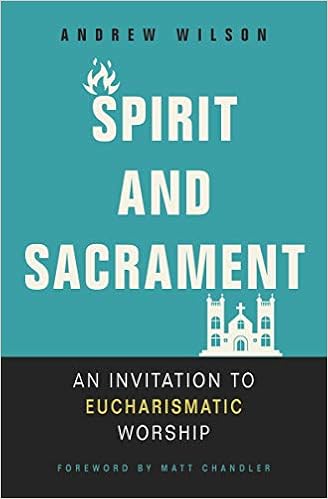
Andrew Wilson's Spirit and Sacrament review

Spirit and Sacrament: An Invitation to Eucharismatic Worship
Andrew Wilson


The most enjoyable book I've read this year. Clearly written by a preacher-scholar rather than a scholar alone, the rhetorical flourishes made this book a joy to read.

I really wanted to read Schreiner's and Wilson's book close to each other, and managed to fit both of them in within a week. They were both written concisely and clearly and with a view to a general audience, but without holding back from entering into serious discussion when warranted.

This book was an exhortation, or, as Wilson describes it, an invitation, to "eucharismatic worship"; essentially this means taking tradition and in particular the liturgy more seriously, but also zealously pursuing the spiritual gifts. These dual perspectives made for a more well-rounded book than Schreiner's, although it's a little unfair to compare as Schreiner had only one purpose (to make the case for cessationism). Nonetheless, by combining them, Wilson well made the point that the two aspects (liturgy + charismata) both have a history which we discard to our detriment. To be a historically faithful Christian is to celebrate all that is in the liturgy (at the forefront is the eucharist but also the elements of confession, thanksgiving, creeds and so on) but also to pursue and practice the spectacular spiritual gifts (my term) in continuity with NT Christianity as well as the early church.

As Schreiner said in his ETS paper published in Themelios, the very least a cessationist should take away from this book is the importance of the liturgy. But this is similarly a very good case for an historically rooted and orderly practiced charismata.

Apart from being a joy to read, the overwhelming impression was the generosity with which his view and the alternate views were presented. There was no point at which anyone was called anathema (although perhaps those who refuse to celebrate communion might be in danger of this!), but rather people of differing opinions and histories were reminded firstly of the primacy of our unity in Christ. I'm very thankful to have read this book and will continue to reflect on the implications.

Monday, July 22, 2019

Brief review of Schreiner's "Spiritual Gifts"


Spiritual Gifts

A few months ago there was an interesting discussion between Thomas Schreiner (cessationist) and Andrew Wilson (continuationist), which led to a debate and dominated a recent edition of Themelios. I ordered their books on spiritual gifts and wasn't sure which to read first, but Schreiner's arrived first, and I read most of it on a plane last week and finished it this morning (172pp with large font and lots of white space).

Here is my very brief review. I will probably have more to say once I've read Wilson's book.

Spiritual Gifts: What They Are and Why They Matter
by Thomas R. Schreiner


Good little primer on a case for cessationism. There were a few leaps of logic and I really wanted more detail at several key points, but overall it was not a bad book.

I disagreed with Schreiner's discussion on Acts 8, as I read the receipt of the Holy Spirit after their belief as the remarkable outward manifestation of the Spirit, not as indicating a lack of receipt in the first instance.

Similarly I was unsure why the discussion on the fallibility of prophecy was required and so long, but there must be a debate I'm unfamiliar with that he was entering into.

The irenic tone of the book was much appreciated and I look forward to reading Andrew Wilson's book next as a companion to this.

Tuesday, July 16, 2019

Psalm 123 Structure

This year's preaching has been mostly Acts during school terms, and the Psalms of Ascent (120-134) over the school holidays. My first psalm was 123, which has an interesting structure as shown below:

After the heading (1a), the psalm divides into three based on the three verbs present:

  • 1b-2c נשׂא (to lift up)
  • 2d-3a חנן (to be gracious)
  • 3b-4 שׂבע (to fill)

As is evident from from the passage, נשׂא only occurs once, in 1b, but is assumed throughout verse 2: what is done with the eyes there is that they are lifted up as per verse 1.

In the second paragraph חנן occurs three times in rapid succession, a prayer to the one to whom the pilgrim's eyes are lifted.

Finally, the third paragraph gives the reason behind the plea, namely the filing with contempt. It is structured with שׂבע occuring once in each of the first two lines, and is also bookended with בוז (contempt) (3b,4c).

As can be seen, although the psalm can be divided into three paragraphs based on the use of each of the three verbs, the logic flows between them so that the psalm is very tightly held together based on verses (1-2,3,4) as well as by verbs (1b-2c,2d-3a,3b-4).

Monday, June 10, 2019

Review of Behind the Scenes of the Old Testament

JONATHAN S. GREER, JOHN W. HILBER, JOHN H. WALTON (eds.) Behind the Scenes of the Old Testament: Cultural, Social, and Historical Contexts (Grand Rapids, Mich.: Baker, 2018) Pp. xix + 615. Hardcover. $22.60.


Greer, Hilber and Walton have brought together a diverse group of authors in order to bring to life the world in which the Old Testament was composed and lived. Divided into ten sections, along with a very brief (3 pages) introduction and much longer bibliography, Scripture, ancient works and author reference (101 pages), this work is divided into three parts of the “drama” that is the Old Testament, which is then further divided into ten sections, and then further into sixty-six chapters. The first part describes the “elements” (geography, archaeology, ancient Near Eastern literature and ancient Near Eastern iconography); the second describes the “acts and scenes” (approaches to the historical contexts); and the third third, taking up almost half of the book, walks through the “themes” of the drama (Israelite religion, family networks, economic contexts and social organisation). The dramatic approach to the naming of parts and sections is cute and sets the scene, but while it doesn’t necessarily add too much, it doesn’t detract and helps the reader mentally categorise the parts.

This book is intended as a reference work, where students would be directed to read one or several chapters on a particular topic from a specialist in that area. Occasionally this means some authors will assume too much (for instance the dating of archaeological periods) while others will dumb things down too much. Also evident is a lack of communication between the authors of related chapters, where advice of caution from one author will be ignored by another who goes out on a limb. One example of this is chapter 42 (Walton: “Interactions in the Ancient Cognitive Environment”) where, of the multiple models of interaction between the ancient Near Eastern texts and biblical authors, “diffusion” is the wisest and most cautious approach. Contrast this with the following chapter (Matthew J. Lynch: “Monotheism in Ancient Israel”) where the author posits a very definite polemical relationship despite the caution suggested in the previous chapter. 

Some chapters in this book described subjects from specialities many may never have imagined existed: Historical Geography (ch’s 1–4), Levantine Earthquakes (ch 39), Metallurgy (ch 57), Ancient Technologies and Food Preparation (ch’s 58–59), Social Stratification in the Iron Age Levant (ch 63). Many chapters demonstrated holistic methodologies, incorporating geography, archaeology, iconography, non-biblical and biblical texts. Some chapters, although not enough, showed how this worked in practice and enabled the reader to approach the biblical text from a fresh perspective that properly takes into account the “scenes” in which it originated and described.

There were some good uses of diagrams and pictures (although grey-scale diagrams in ch. 4 provided colours too similar to be of help, and the number of pictures of Cyprian women making pots (ch 58) were more than ample). Generally sketches of icons and texts were appropriate and served their purpose well.

There were some sections which could have been arranged differently, or parts of a chapter later in a section which would have fitted better in an earlier chapter in a separate introductory chapter. For example, the closest we have to a diagram of the “traditional four-room house” comes finally in chapter 58 (a diagram of a five-room house), even though a working knowledge of such a dwelling is assumed knowledge all the way back in chapter 9. Similarly the working definition of the ranges for the bronze and iron ages come in chapter 8 but are assumed in chapters 5–7. So too the description of the family tree of Semitic languages comes in chapter 16 but should probably have preceded chapter 12 for context. 

One chapter which really needed to be in “Section V: Acts: Integrated Approaches to Broad Historical Contexts,” was inexplicably absent. The section moved dutifully through the Ancestral Period (ch 23), the Egyptian Sojourn and the Exodus (ch 24), through to the Achaemenid Persian Empire in the West and Persian-Period Yehud (ch 30) but then skips the entire Greek period, jumping straight to the Maccabean Revolt and Hasmonean Statecraft (ch 31). Although Alexander the Great and Hellenism (ch 41) does get a mention in “Section VI: Scenes: Integrated Approaches to Event-Based Historical Contexts,” the approach there is from a different perspective and is really an inexplicable absence in this otherwise comprehensive book. A discussion of the Seleucid and Ptolemaic empires and their impact on the Levant is of inestimable importance and its absence is perhaps the book’s most glaring flaw.

The best chapters included those which provided clear overviews (in particular, ch’s 1, 5, 11, 19, 42, 53), while the final three chapters (“Law and Legal Systems in Ancient Israel,” “Wisdom Traditions in Ancient Israel,” “Warfare in the World of the Bible”) were perhaps the most engaging and finished the book well. These, among with multiple others, will be perfect set-reading for students as they are taught to approach the Old Testament in its world and with an increased awareness of all that is going on behind the scenes.

Monday, April 15, 2019

Concentric Structures in Lamentations 4

Looking at this chapter was the first time I was prompted to think that concentric structures may be a important to the style of composition in Lamentations. The chapter breaks down in a fairly self-explanatory manner and several features present themselves through the structure.


A     4:1-10
a 1-2 the destruction of my people
b 2 the cruelty of my people
c 4 hunger
d 5 elites upended
e` 6 great iniquity
d` 7-8 elites upended
c` 9 hunger
b` 10a-c the cruelty of my people
a` 10d the destruction of daughter my people

B     4:11-16
a 11 Yhwh has done it
b 12 the nations against Zion
c 13-15b the sins and iniquities of prophets and priests
b` 15c the nations against Zion
a` 16 Yhwh has done it

C     4:17-20
a 17 our eyes
b 18a our steps
c our end was nigh
d our days are complete
c` our end is come
b` 19 their steps
a` 20 our life-breath

D     4:21-22
a 21 Daughter Edom
b 22a Daughter Zion
a` 22b Daughter Edom


Although the majority of chapter 4 is in the third-person, in the A section the first-person suffix is a hint that there is a person reporting this. The section works in from the destruction of my people, through the way the people have become cruel, the hunger evident in the populace, highlighted through the way the elites are now unrecognisable through their suffering. The centre of A coming in v6, as their iniquity is described as greater than that of Sodom, which earned Sodom a mercifully quick death, while Zion's death is ongoing.

The B section is bookended with the divine name, Yhwh, who is singled out for having wrought the punishment upon his people. The nations are mentioned, first directly, then indirectly as the voice of those rejecting refugees from Jerusalem. The centre is the iniquity of the prophets and priests, the seers who are now blind, and the purifiers who are now defiled.

I am less certain about the structure of the C section, but I am certain that it is a section, as in 4:17-20 the first-person plural appears for the first time, as the people together lament their state.this culminates in 4:18b-d, where the end is nigh, their days are complete, and the end is come.

Finally the D section describes the current and future states of both Edom and Zion, with Edom currently rejoicing but soon to be punished, while Zion is currently suffering but her punishment is complete.

Chapter 4 is a tightly structured chapter, with sin highlighted in the first two sections, the completeness in the third, and the extent of the punishment explained in the final section.

Concentric structures in Lamentations 5


When we started Lamentations, I was looking around for concentric structures in Lamentations, but a lot of them felt quite artificial. So I wasn't really looking for any when a couple of them just appeared. This one is for chapter 5, and next time around I'll point out some similar features in chapter 4.

A    5:1
Dear Yhwh,
Remember, look and see

B    5:2-10
a how far we have fallen
   b punished for the sins of our fathers
a how far we have fallen

C    5:11-14
four pairs of persons,
showing how far away their hope is,
how completely they've been upended

B`   5:15-18
a good things upended
   b woe to us for we've sinned
a the result of this is our lament

A`   5:19-20
Dear Yhwh,
although you are enthroned forever.
you don't remember, you neither look nor see

A``   5:21-22
Dear Yhwh, 
we pray you bring us back
but instead you reject us


The main thing to note here is how the chapter begins and ends with mentions of Yhwh, with the divine name absent in the intervening verses. As such, they form something of a prayer.

The second thing is the two mentions of sin, in 5:7,16. These both occur in the centre of first-person plural sections (1-10, 15-19), while the intervening section (5:11-14) is third-person. That intervening section is set apart with the distinctiveness of the four pairs of persons.

I'm not convinced there is anything to make out of C in particular as the central section, as the main action is really happening in the A and B sections, with the recognition of inherited and continued sin in the B sections, and the addresses to Yhwh which bookend the chapter.

Monday, February 11, 2019

Structure of Titus 2

Reading Titus 2 with someone this morning we noticed the following concentric structure:
Older Men
         3 Older Women
         4-5 Younger Women
 Younger Men 
It is noteworthy that while the older women are to mentor the younger women, there is no corresponding expectation for the older men toward the younger men. Perhaps this explains the concentric structure.


Furthermore, it's also interesting to see the concentric structure in the commands to the older women (2:3), with two positive commands framing two negative commands:
do live reverently
        don't be slanderers
        don't be drunkards
do teach what is good
Perhaps Paul is encouraging the "sandwich technique" of giving feedback to these women, modelling to Titus how to teach older women from his position as a younger man. 


Saturday, February 02, 2019

Chiasms in Acts 1

We're starting a year preaching through Acts, and this week is the beginning of all that. There are two chiastic structures in the first chapter which grabbed my eye (undoubtedly there are others). The first is on the micro-scale, while the other encompasses the second of three parts of this chapter.

Acts 1:2

This first one is a syntactical chiasm, which means that to read it logically you need to follow a chiastic structure.
ἄχρι ἧς ἡμέρας
        ἐντειλάμενος τοῖς ἀποστόλοις
                διὰ πνεύματος ἁγίου
        οὓς ἐξελέξατο
ἀνελήμφθη.   
If you were to read it out in the written order, it would be: Until the day, having commanded the apostles, by the Holy Spirit, whom (plural) he had chosen, he was taken up.

But by rearranging the clauses by matching the first and last, second and fourth, and then central, gives you the English order: Until the day he was taken up, having commanded the apostles whom he had chosen, by the Holy Spirit. 

Why do this? I would guess to put the concept of the choosing of the Holy Spirit central, as this theme will reoccur often in the book, especially in chapter 2, but also in the choosing of Matthias to replace Judas.

Acts 1:4-8

This second one is what I am now trying to call a concentric or ring structure, which is organised more along thematic lines as follows:
4a Geography (don't leave Jerusalem)
        4a-5 Holy Spirit (you'll receive the promised Holy Spirit just as John spoke of)
                6 Kingdom (which kingdom will this be? cf Kingdom of God in 1:3)
        7-8a Holy Spirit (you will receive power as you receive the Holy Spirit)
8b Geography (You will go out from Jerusalem to the ends of the earth)
Again, why? Well, the book of Acts will work as a travelogue, more or less following the course described in 1:8b, from Jerusalem to the ends of the earth. Secondly, the Holy Spirit will be present and directing all the work that happens in evangelism and strengthening. And thirdly, God's kingdom will be continually contrasted with the kingdoms of this earth (in particular Rome), and shown to be not only superior but also eternal and centred around Jesus the king.